
On Monday, a US judge ruled that Google search is an illegal monopoly in this landmark antitrust case. As website owners await the imminent algorithm update, Google is now facing its own challenges following the ruling.
The search engine that dominates the world has been ruled to have crushed its competition through exclusivity deals and search ads. But will the court ruling topple the king of search?
I unpack the case below and share what’s next for Google as the US court determines a punishment to fit the crime.
A Groundbreaking Case
Google was originally sued by the US Department of Justice in 2020, in a challenge to its search engine market dominance and potential violation of antitrust laws. As of 2024, Google controls over 90% of the search engine market. Bing, the next largest search engine, controls roughly 4%.
Following a trial that lasted 10 weeks, US District Judge Amit Mehta concluded that Google acted illegally to maintain its monopoly over search. But how did Google achieve this? By paying billions of dollars to be the default search engine across a range of devices and browsers, such as Apple and Samsung.
With the size of Google and its available resources, it’s hard for other search engines to compete, especially with most users preferring Google over alternative options. In fact, the top searched term on Bing is “google.com”, according to the court case.
Thanks to Google’s dominance over the market, the company has been able to charge higher prices for search ads, too.
In the 286-page court ruling, Judge Mehta wrote:
“Google is a monopolist, and it has acted as one to maintain its monopoly.”
Key Takeaways from the Case 🔍
- Google has paid billions to be the default search engine across devices, including Apple and Android
- Google can raise ad prices to increase revenue and large advertisers can’t afford to avoid Google entirely
- Most people using Windows (with a default Bing browser) download Chrome to use Google
- Microsoft wanted Apple to make Bing a default search engine with 100% of Bing revenue, but Apple refused because Bing was “horrible at monetizing advertising”
- Google has used click data from search queries to train systems, including Navboost
What’s Next for Google?
Google has officially responded to the DOJ ruling on X, declaring its intention to appeal the verdict:
“This decision recognizes that Google offers the best search engine, but concludes that we shouldn’t be allowed to make it easily available. We appreciate the Court’s finding that Google is ‘the industry’s highest quality search engine, which has earned Google the trust of hundreds of millions of daily users,’ that Google ‘has long been the best search engine, particularly on mobile devices,’ ‘has continued to innovate in search’ and that ‘Apple and Mozilla occasionally assess Google’s search quality relative to its rivals and find Google’s to be superior.’ Given this, and that people are increasingly looking for information in more and more ways, we plan to appeal. As this process continues, we will remain focused on making products that people find helpful and easy to use. – Kent Walker, President, Global Affairs”
The statement is interesting and quite dismissive of the ruling – Google steers clear of recognizing the US judge’s verdict that it maintains a monopoly on search. Instead, Google declares itself the “best search engine” and is grateful for the court’s reminder that millions of users trust the tech giant. That’s certainly one interpretation of the case.
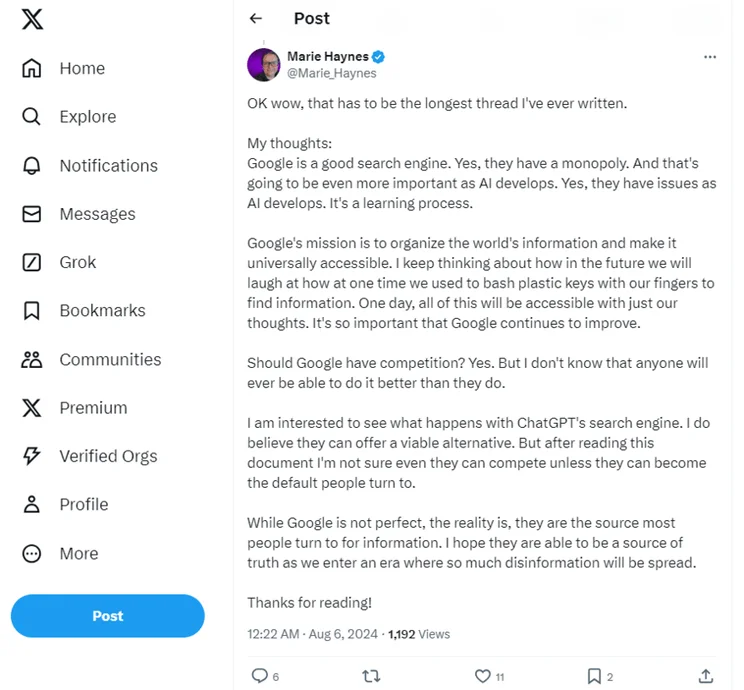
Marie Haynes, an SEO and Google expert, did a deep dive into the case on X, saying: “Should Google have competition? Yes. But I don’t know that anyone will ever be able to do it better than they do.”
What Penalty Could Google Face?
The verdict was only announced yesterday, so Google’s penalty is not known yet, and Judge Mehta will hold a separate trial to determine the next steps. The US government has requested “structural relief”, which implies the possibility of breaking down the company structure.
However, I’d argue this is an unlikely outcome given Google’s intent to challenge the verdict and its popularity with users. Plus, it’s a turbulent time to be taking on a tech giant like Google given the upcoming election, particularly with both parties hoping to court Big Tech.
This isn’t Google’s first antitrust rodeo. Google was fined €4.125 billion in an antitrust case with the European Commission back in September 2022, meaning Google has now lost twice in disputes over its search monopoly. This sizable EU fine could influence the US when determining an appropriate penalty. However, with Google’s deep pockets, a fine is a soft penalty to face.
I spoke with Audience and SEO Development Strategist, Caitlin Hathaway, about potential outcomes for Google:
Google may not be allowed to partner with mobile devices to be the default search engine in the US going forward. Mobile users may instead be offered a list of search engines they can pick from – this would likely have an impact on people choosing Google as their default. But, as people are so used to using Google (even proven by the verb ‘googling’), this may only be a small impact as the other search engines are much smaller. And, as the court stated, Google is ‘the highest quality search engine’, which means people still may pick it.

Whatever the penalty, the outcome of this trial is still a huge blow to Google, especially in the wake of a changing search landscape. As major players, including Google and Bing, continue to invest more in AI search assistants, online search will change regardless. OpenAI even added its own player into the mix with SearchGPT in late July. That said, Google will likely remain at the head of the table for the foreseeable future.
Will the verdict really change anything or will the tech giant simply be given another fine? Stay tuned for updates.





0 comments