
Knowing your target audience like the back of your hand is crucial for online success. By understanding which platforms you can find them on and the types of content they enjoy, you’ll be able to craft a tailored strategy that’ll help you grow your business on social media.
If you want to know how to find your target audience on social media, this guide is for you! I’ll break it down into eight steps, from initially defining your ideal users to crafting compelling content to engagement strategies.
- Get to know your target audience by creating detailed user personas for each of your audience segments. These will not only guide the social media platform(s) you use, but also help you create content they find valuable and entertaining.
- Preempt trends and adapt quickly to changes in user behavior, and you’ll be ahead of many competitors. Market research, competitor analysis, and social listening tools are the best ways to achieve this, since they’ll give you a holistic view of your industry.
- Consistency across platforms is key when it comes to creating a recognizable brand on social media. It’s important to have a clear idea of how you want your business to be perceived before you start posting and to make sure everyone with access to your social media accounts is on the same page.
1. Define Your Audience
You can’t get to know a stranger based on their name alone. You also need to understand what their interests are, where they’re based, how old they are, their gender, their background, and more.
Understanding social media users is the same – with 5.24 billion users, it’s important to have a laser focus on who your target audience is, and make active steps to reach this specific group of people. Visualising each of your audience groups as a real buyer, known as a buyer persona, will help you with this.
💡 For more support on this, check out our top persona examples.
Target Audiences
Your target audiences are tied together by a common trait or characteristic. Identifying these customer segments will allow you to tailor your social media strategy to meet each group’s unique needs. The key segmentation groups for consumers are:
- Demographics: User demographics are based on populational statistics, such as age, gender, income, and education level.
- Location: Many businesses target groups based on their locations, which could be as broad as a country or state, or zone in on a neighborhood.
- Purchase Behaviour: This entails why consumers buy your products, and what they hope to gain from them.
- Interests and hobbies: Audiences grouped by hobbies and interests can guide the angle of your posts to connect with that segment.

2. Competitor Analysis
Understanding who you’re competing against for your target audience’s attention will help you position your brand to stand out. Find four or five of your closest competitors, and visit their social media channels. Ask yourself:
- What social media platforms do they use?
- How often do they post on their channels?
- What topics do they cover?
- What content formats perform best?
Top Tip💡 Meta provides hidden insights into your competitors’ advertising targeting preferences. When you come across their Facebook ads or Instagram ads, select “Why am I seeing this ad?” to see specifications on how they target their audience.
Tools such as Metricool streamline the competitor analysis process and help you to benchmark your performance. By linking your social media accounts and inputting your competitors, it’ll constantly track their social media presence and provide insights into their top performing posts, online growth, and key engagement metrics.
3. Find Your Community
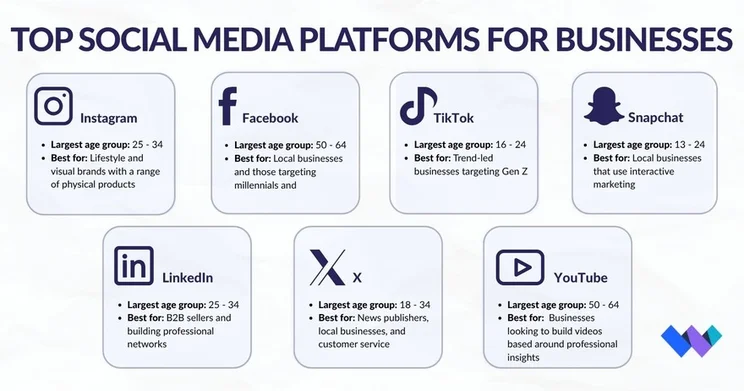
Now you know who your target audience is, you need to find out where they spend their time online. Look into social media platform demographics and see which is the closest match.
For example, X’s audience has a largely male skew (63.7%), whereas Snapchat and Instagram have the highest proportion of female users.
If your audience is primarily Gen Z, you’d be best using TikTok or Snapchat. On the other hand, research shows that YouTube and Facebook are best for targeting the 50-64 age group, since 86% are active on YouTube and 70% on Facebook.
Identifying the social media platforms your target audience use will inform where you start your own social media journey. Take a look at our social media fact sheet to see which could be a good choice for you:
4. Look at Industry Trends
To understand how to reach your target audience on social media, it’s important to carry out market research into your industry. This will help you spot emerging trends, shifts, and patterns in your target audience’s behavior, and inform changes to your social media strategy.
Social listening tools, such as Hootsuite and Sproutsocial, are an effective way to carry out market research. They work by monitoring mentions, keywords, and hashtags relevant to your brand and product across social media platforms, so that you can find their current preferences, pain points, and general customer feedback.
Once you have this data, it can be analyzed to predict trends relevant to your target audience and industry, which means you can adapt your content strategy beforehand and get ahead of your competitors.
Top Tip: Check out our guide on how to find TikTok trends to better understand how trends work on TikTok. Or, for general trending themes, Yelp’s Trend Tracker provides a round up of monthly search trends, with suggestions for businesses that can utilize them.
Jumping on social media trends is an effective way to engage audiences and build new ones – social media algorithms love them. But remember: imitating others won’t help your brand. Instead, only participate in trends that resonate with your business and products, and tailor them to your brand personality and style.
5. Carve Out Your USP
Millions of businesses use social media, so it’s important to know how to leverage your unique selling point (USP) as a way to stand out from competitors. Firstly, you need to hone in on what makes you different. This could be:
- A product or service, or a feature of either
- Your brand personality
Then, it’s all about creating engaging content that drives these points home to your audience. Use a mixture of visuals, such as graphs, infographics, and customer testimonials to show this, and maintain consistency across all your platforms.
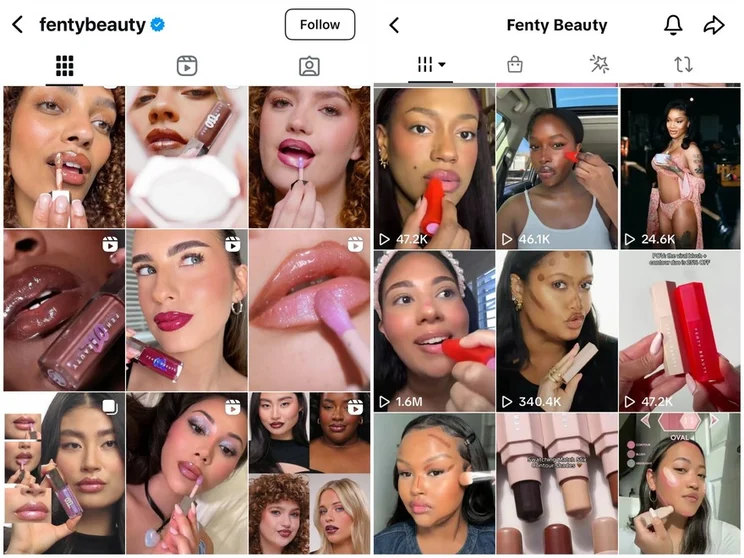
For example, Fenty Beauty’s USP is its diverse range of makeup shades made for every skin tone. This is made instantly clear from its TikTok and Instagram accounts, which show side-by-side product variants and user-generated content (UGC) from creators with an array of skin tones.
6. Keep a Consistent Tone of Voice
Among other aspects of your online branding, the tone of voice your business uses holds a lot of power over your audience’s overall perception. Whether you want to build an online brand that’s sassy, formal, conversational, or something else entirely, it’ll only become a recognizable part of your brand personality if you use it consistently – on every platform and every type of post.
Of course, each platform has its nuances that you’ll need to tailor your tone of voice to suit. For instance, a casual, attention-grabbing approach works best on TikTok and Snapchat, whereas LinkedIn users often prefer a carefully constructed thought provoking style.
However you work around these differences, your core tone of voice should still be evident.
The Importance of Style Guides
Creating a set of overall brand guidelines and a clear style guide will help to iron out all the important details of how your brand should portray itself. If you have multiple staff, they’ll also help you set expectations and act as a handy reference. Your style guide should include:
- Your brand’s tone of voice, and how it differs across platforms
- Your overall goals for how you aim to help your audience
- Any specific formatting, words, phrases, and hashtags
- Media standards: Such as minimum quality and size of photos, length of videos, or number of posts in a carousel
Top Tip 💡 Be sure to add enough detail to your style guide so that there isn’t room for misinterpretation. At Website Builder Expert, our tone of voice is confident, empathetic, and conversational. Our style guides break this down by explaining why each of these factors is important, how we achieve it, and what not to do, along with real-life examples.
7. Create Content for Your Audience
People are more likely to buy your products if they buy into your brand. Luckily, with time and consistency, social media is the perfect place to grow trust and authoritativeness.
To achieve this, every piece of textual and visual content you publish should be considered valuable to your audience and of high quality. This doesn’t rule out spontaneous story posts by any means – just put yourself in the shoes of your audience and think about whether they would find it interesting or useful.
- Create content for all stages of the sales funnel: Maximize the effectiveness of your social profiles by creating content that fulfills every type of user. For a restaurant using Instagram, this might mean informative content, such as policies and pictures of your menu items, for those at the top of the funnel, and promotions and restaurant reviews to seal the deal at the decision stage.
- Make use of user-generated content: How better to reach your target audience than with posts made by them? User-generated reviews and product demos are a great way to demonstrate trust and relatability.
- Test different content elements, formats, lengths, placements, and posting times: There isn’t one right way to post online, so A/B testing is the best way to tailor your content to your audience’s unique needs.
8. Engage With Your Audience
Posting regular, high-quality content will put you in a great position with your audience. However, engaging with them in between your posting schedule is what will deepen these relationships.
My top recommendations to engage effectively are:
- Set aside time for responding to comments and direct messages: These can quickly build up and become unmanageable, so it’s good to keep on top of this by setting aside response time daily, or at least two to three times per week.
- Share UGC: This is a great way to show your appreciation for the customers singing your praises, and encourages new sales.
- Create dedicated posts to respond to customers: If you’ve had an influx of similar questions, video responses will help to increase clarity and stop you having to answer the same queries. TikTok has features dedicated to this, such as video comment replies and stitches.
- Hold Q&A sessions: Live streams and Stories are great for hosting real-time question and answers. These can be general, or you can invite your audience to ask questions related to a specific product or area of your business, such as your shipping process.
Summary
This article has shown you how to find and engage with your target audience on Instagram, Facebook, TikTok – you name it.
Nailing your target audience is foundational, and opens many other doors to ramp up your social media strategy, such as creating effective paid ads on TikTok or building a killer influencer marketing strategy that appeals to your audience.


0 comments