
This article will show you seven alternatives to BigCommerce, helping you find an online store builder.
Through testing, we’ve found that BigCommerce can be relatively tricky to use. It uses complicated language, and has a steeper learning curve compared to most website builders. Those with limited tech knowledge may struggle with BigCommerce. Fortunately, we’ve done the research, and found seven alternatives for you.
The 7 best alternatives to BigCommerce are:
- Shopify – best overall ecommerce platform
- Wix – best generic website builder with ecommerce functionality
- Squarespace – best designed templates
- Weebly – best value for money
- Volusion – great analytics features
- GoDaddy – easiest to use
- Shift4Shop – extensive backend
This article will take you on a tour through seven of the best BigCommerce alternatives. We’ll uncover the strengths, weaknesses, and prices of each platform, helping you make an informed decision.
Let the tour of BigCommerce alternatives commence…
Best Alternatives to BigCommerce
It’s our job to find you the right ecommerce platform for your online store. We’ve done our research and found the seven best BigCommerce alternatives, which we mentioned above.
Some of these platforms, like Shopify, Volusion and Shift4Shop, are ecommerce specific builders.
This means they have been designed purely to build online stores, offering powerful inventory management tools.
The remaining platforms – Wix, Squarespace, Weebly, and GoDaddy – are website builders with ecommerce functionality. This means they’re better suited to creating attractive websites which sell a few products, rather than dedicated online stores.
It’s estimated that there will be over two billion global digital buyers in 2021, so you’ll want to choose the right website builder to make the huge ecommerce market work for your purposes. We’ll now go into more detail on each platform below…
Compare Each Ecommerce Platform.
Or, check out our Best Ecommerce Website Builders page.
And for more detail on each platform with our Best Ecommerce Platforms Page.
#1 Shopify
Best all-around ecommerce platform
Shopify topped nearly every category in our user testing. Is it any surprise it ranks at number one in our list? Nope.
Shopify is simply the best because it’s so comprehensive. It covers all the areas you need for selling online easily, and covers them well. It’s easy to use, has great business tools, and offers superb customer support.
Better still, Shopify’s pricing is nothing to be scared of. There are three core price plans costing $29, $79, and $299 per month, all giving you stronger features the more you pay.

Shopify Pros and Cons
- •Built-in features: You don’t have to rely very much on third-party apps for full functionality, and it won’t drive up the costs
- •Scalability: Beginner plans start under $30/month, while the top plans can support brands like Toyota and Ben & Jerry’s
- •Multi-channel integration: It’s easy to sell across multiple marketplaces and keep products organized and tracked with SEO
- •Not the easiest to use: BigCommerce’s powerful platform means that there’s a learning curve involved, and customizing your design can be tricky
- • Complex terminology: This one is no biggie, just have Google open in a separate tab!
- •Price: BigCommerce can get expensive beyond the first plan
Check out our full Shopify Review for more information
BigCommerce vs Shopify. Who wins? Click the link to find out.
#2 Wix
Best website builder with ecommerce functionality
You can’t do much better than Wix when it comes to building websites, but how does it fare when creating online stores? Perhaps unsurprisingly, it’s really good at that, too.
Wix is a popular platform because it’s so easy to use, and Wix eCcommerce is no different. The intuitive drag-and-drop feature lets you customize your store with ease, while you can also add product videos to lure in customers. You’ll also benefit from excellent SEO (Search Engine Optimization) features to help your website rank higher on Google.
Wix also offers Wix ADI (Artificial Design Intelligence), which helps build your store in a matter of minutes. Simply answer a few questions, and Wix creates a website, just like that.
Wix does have a free plan, but in order to sell stuff, you will need to upgrade to a premium plan. These range from just $16.00 to $59 per month.

Wix Ecommerce Pros and Cons
- • Very easy to use
- • Add product videos
- • No abandoned cart recovery feature
- • No multi channel selling
Read our in-depth Wix Ecommerce Review for a deeper insight.
Wix vs Shopify. Click the link to see who comes out on top.
#3 Squarespace
Best designed templates
The industry leader for design, Squarespace casts a shining light on your products. It may make your online store look good, but how does it make your store perform?
Squarespace isn’t just a pretty face – it actually has real depth and quality to its features, particularly with its social media integration tools. You also have access to some useful analytics tools to help you manage your site’s growth.
Squarespace lacks numerous payment options and an app market, meaning you’re restricted to its built-in features. However, it still scored highly in our ‘value for money’ testing, with price plans ranging from $16 to $49 per month.

Squarespace Ecommerce Pros and Cons
- • High quality features
- • Best design
- • Lacks a variety of payment options
- • No app store
Squarespace Ecommerce Review – Learn about how Squarespace can help your business
Shopify vs Squarespace – A close match?
#4 Weebly
Best value for money
With Weebly, you don’t need to worry much about costs. It comes in as the best value for money platform on our list, so you can already see the positives for smaller businesses.
Weebly is also really easy to use, thanks to its drag-and-drop interface. In terms of features, it’s great for blogging, provides password protected pages, and has recently integrated with popular payment gateway, Square.
We’d recommend selling elsewhere if you have more than 30 products, because Weebly just doesn’t have the capabilities. It lacks store inventory management tools, and you cannot sell across multiple channels.
However for the price, you can’t complain. You can build an ecommerce store with Weebly from just $8 per month.
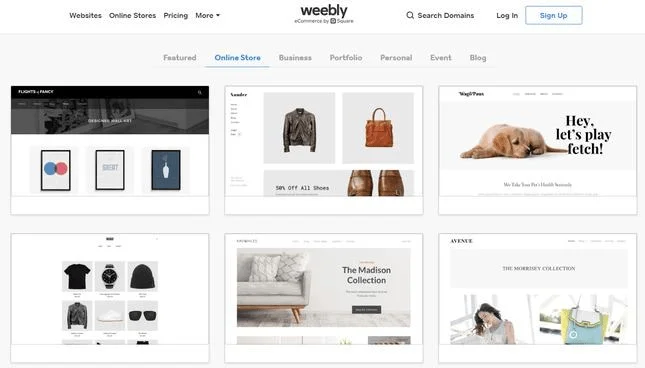
Weebly Ecommerce Pros and Cons
- • Easy to use
- • Best value for money
- • Cannot update stock levels
- • No multi channel selling
Read our in-depth Weebly Ecommerce Review.
#5 Volusion
Great analytics features
Volusion is a middleweight in the ecommerce ring, but it does pack a punch with its data analytics tools. Its mediocre ratings in our research come down to its lack of niche features, its lack of blogging tools, and the fact that it’s quite hard to use.
Volusion performs well in the payment area, integrating with plenty of gateways including Apple Pay, PayPal and Stripe. It also comes with a mobile app, letting you manage your store on the move.
It has five price plans starting from $15 per month, but you can pay just $13.50 per month if you sign up for a year.
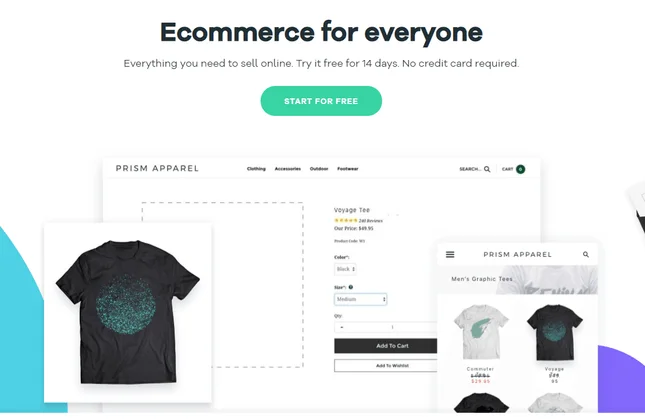
Volusion Pros and Cons
- • Cannot sell digital products
- • Lacks blogging feature
- • Cannot update stock levels
- • No multi channel selling
Or, check out our full Volusion Review for more information.
#6 GoDaddy
Easiest to use
Quick and easy – two of the most wonderful words for any business owner. And GoDaddy makes building an online store just that.
Using ADI (Artificial Design Intelligence) named GoCentral, you can create an ecommerce store in just a few moments. If website building was a race, GoDaddy is Usain Bolt, and BigCommerce is your average joe.
However, GoDaddy doesn’t offer much aside from speed. There’s not much creative freedom, the features lack quality, and it’s tricky to integrate blogs.
The pricing is easy to factor into your budget, though, with its flat fee of $19.99 per month.

GoDaddy Pros and Cons
- • Fastest to build and easiest to use
- • Can switch themes after publishing
- • Features lack quality
- • Not much creative freedom
Wanna go with GoDaddy? Read our full review.
#7 Shift4Shop
Extensive backend
Last, but arguably not least, is Shift4Shop. It scored poorly in our user testing, gaining the infamous title of ‘least likely to be recommended’. However, it’s not all doom and gloom – Shift4Shop has a really impressive backend.
Despite our participants’ unpopular opinion, Shift4Shop has fantastic SEO prompts, and offers lots of inventory management control. You can also change themes anytime you want.
Prices start at $17.10 per month, so it’s not the cheapest platform around – but if you’re confident with a keyboard and mouse, you could do a lot worse than Shift4Shop.
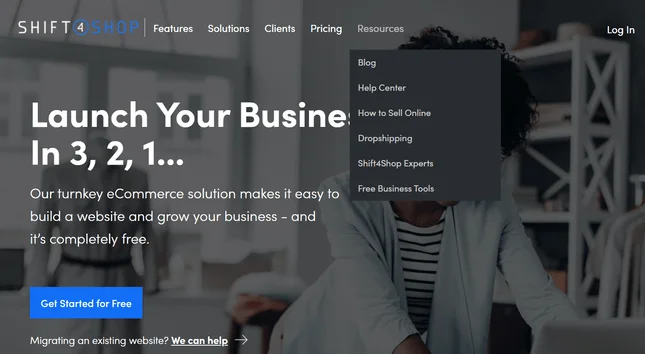
Shift4Shop Pros and Cons
- • Superb SEO prompts
- • Extensive backend
- • Relatively expensive platform
- • No mobile app
Want to add this platform to your shopping cart? Read our full Shift4Shop Review.
What About Open Source Ecommerce Platforms?
We love website builders – surprising, right? – and will always recommend them highly. But there are other options out there. For starters, you may also want to consider open source platforms.
An open source platform gives you unlimited customization through coding, but you’ll have to organise web hosting and website security yourself.
Website builders are ready to use, out-the-box softwares, while open source platforms require a lot more effort to build your website. In short, open source platforms are much harder to use.
One open source platform, WooCommerce, is the specific plugin for WordPress. So you’ll need a WordPress website to use it. Magento is another popular open source platform, currently powering 250,000 online stores.
They’re both free to use, but you will spend a lot of time and effort building your website, which could be spent concentrating on other aspects of your business.
Shopify vs BigCommerce vs WooCommerce – Who wins the triple battle?
How to Choose an Alternative to BigCommerce
When choosing a BigCommerce alternative, there are some things to consider:
- Ease of use
- Quality of features
- Third party integrations
- Pricing
- Design flexibility
- Build time
It’s worth remembering that every platform offers either a free plan or free trial, so you can build your online store and start your ecommerce journey at no cost.
Is BigCommerce Right for You?
Have you found your perfect alternative? If not, don’t worry – BigCommerce might be the best choice for you after all.
It has the highest quality and quantity of built-in features of any ecommerce platform, so you don’t need to worry about searching for and buying apps. It’s also perfect for fast growing businesses, offering everything you need to expand into an ecommerce empire.
It could improve its user experience – there’s an awful lot of jargon on the interface – but it’s a solid choice for big businesses looking to sustain success online. What’s more, it scored highly in our testing in categories like sales features, website features, and value for money.
Still convinced by BigCommerce? Read our full review for more information.
Best Alternatives to BigCommerce: Summary
We’ve shown you seven of the biggest ecommerce website builder names in the market. Having explained each platform’s pros and cons, you should have an idea of which one to choose if you aren’t happy with BigCommerce.
When choosing a platform, there are some important things to consider. These include ease of use, quality of features, size of app market, design flexibility, pricing, and more.
Once you’ve picked the perfect ecommerce platform, you’re ready to go. And don’t worry about spending money, then regretting it – every platform offers a free trial or a free plan. This means you don’t have to spend big to find an alternative to BigCommerce.
Shopify is the safest bet for serious sellers. It’s the best overall ecommerce platform, providing all the tools you need for succeeding online.
On the other hand, Wix is our top recommendation for smaller online stores. If you’re looking to sell a few products from a brilliant website, Wix wins all day long.


0 comments