
I’ve Tested and Reviewed BigCommerce vs Shopify: Which Is Best for Selling?

We may receive a commission from our partners if you click on a link and purchase a product or service on their website. Learn more

Headshot of Emma Ryan
Written By
Updated on March 12, 2026
Advertisement
We may receive a commission from our partners if you click a link and purchase a product or service. This does not impact our ratings, which are determined by years of hands-on testing and expert research.
Best for side hustles
Starter
See Pricing

$5/month (billed annually)

  • Not a full online store
  • Sell via social media and messaging apps
  • Cheaper than main pricing plans
Best for small businesses
Basic
See Pricing

$29/month (billed annually)

  • 2.9% + $0.30 online card rate
  • Agentic commerce
  • Multichannel selling options
Most popular plan
Best for established stores
Grow
See Pricing

$79/month (billed annually)

  • 2.7% + $0.30 online card rate
  • 5 staff accounts
  • Offers shipping insurance
Best for large businesses
Advanced
See Pricing

$299/month (billed annually)

  • 2.5% + $0.30 online card rate
  • Enhanced 24/7 support
  • Custom reports and analytics
Best for industry leaders
Plus
See Pricing

$2,300/month (3-year plan)

  • Priority 24/7 phone support
  • Unlimited staff accounts
  • Customizable plan
Best for titans of business
Enterprise
See Pricing

Custom pricing

  • Tailored to your business needs
  • Designed for high-growth, high-volume businesses
  • Offers advanced features

When comparing the ecommerce website builders on the market, BigCommerce and Shopify appear time and time again – but which came out on top in our most recent round of hands-on research and testing? After our team spent over 300 hours analyzing the best options for online stores, I can confidently say that Shopify is the clear winner if you want to sell online.In this review, I’ll take a closer look at why Shopify outperforms BigCommerce, and compare the key criteria that your business will be most interested in, including pricing, sales features, ecommerce templates, and more.

I’ve updated this Shopify vs BigCommerce comparison to better reflect the capabilities of each platform in 2026. This includes mentioning any significant product updates, checking information for accuracy, and inserting first-hand experiences from our testers.

Get a quick and clear overview of BigCommerce and Shopify in the table below:

0 of 0
Overall rating
Starting Price
Free plan or free trial
Pros
Cons
Number of templates
shopify
bigcommerce square logo

Shopify

BigCommerce

4.8
3.7

$29

3-day free trial

15-day free trial

  • Unlimited products
  • AI-powered Shopify Magic & Shopify Sidekick tools
  • 100+ payment options
  • Huge app market
  • Multichannel selling
  • POS tools
  • Unlimited products
  • 0% transaction fees on all plans
  • International shipping options
  • Multiple storefronts
  • Mobile-responsive store
  • Limited customization options
  • Additional app costs
  • Lacks built-in features
  • Most templates cost extra
  • Slow performance
  • Limited customization options
  • No built-in AI tools
  • No free custom domain for first year


1,000+

200+

What Kinds of Business Is Shopify or BigCommerce Best For?

Have a specific business need in mind? Here’s a summary of what kinds of businesses Shopify and BigCommerce are best for:

Shopify Is Best for…

  • Scaling, rapidly expanding businesses that need sales tools to best facilitate their growth

BigCommerce Is Best for…

  • Businesses that have a large inventory already and want to easily manage their goods
The Winner

Shopify and BigCommerce’s pricing is the same

Both builders offer three premium plans, ranging from $29 to $299 per month (billed annually). This means Shopify and BigCommerce are both expensive options for selling online.

If you’re looking for the best value builder, Shopify and BigCommerce are evenly matched. Both platforms offer the same pricing structure and are expensive compared to other builders on the market.

How Much Do Shopify and BigCommerce Cost?

Shopify’s pricing ranges from $29 to $299 per month (billed annually) – the same as BigCommerce’s three plans. However, Shopify’s introductory deal means you can get your first 3 months for just $1/month.

You can quickly compare the pricing below:

Shopify Plan (billed annually) Key Shopify Features Per Plan BigCommerce Plan (billed annually) Key BigCommerce Features Per Plan
Basic – $29/mo • Sell an unlimited number of products • 2.9% + 30¢ online transaction fee • Up to 77% discount on shipping costs • Stores can set up 10 different inventory locations • 24/7 support via live chat • Can sell in-person via phone or POS device Standard – $29/mo • Sell an unlimited number of products • No transaction fees • Stores can add unlimited accounts for staff • Stores can set up four different inventory locations • Can sell in-person via POS integrations • 24/7 support via phone, live chat & ticketing
Grow – $79/mo Everything on the Basic plan, and: • 2.7% + 30¢ online transaction fee • Up to 88% discount on shipping costs • Get insurance on shipping • Stores can add five additional accounts for staff Plus – $79/mo Everything on the Standard plan, and: • Stores can set up five different inventory locations • Send abandoned cart reminders to customers • Segment customers to offer tailored promotions • Returning customers can save their credit cards
Advanced – $299/mo Everything on the Grow plan, and: • 2.5% + 30¢ online transaction fee • Stores can add 15 additional accounts for staff • Enhanced 24/7 live chat support • Receive third-party calculated shipping rates Pro – $299/mo Everything on the Plus plan, and: • Stores can set up eight different inventory locations • Customers can filter products when browsing stores

If you’re most interested in the number of features on each pricing plan, Shopify has more sales features than BigCommerce overall. For example, you’ll receive versatile shipping, payment, and multichannel selling options from its cheapest plan.

That said, both Shopify and BigCommerce’s plans are at a high price point. Because of this, I’d recommend avoiding either if you’re a small business with an equally small budget. For more affordable plans, consider GoDaddy or Squarespace instead, whose ecommerce plans start at $20.99 per month and $16 per month, respectively.

The Winner

Shopify’s sales features were unbeaten in our testing

Shopify has an impressive suite of ecommerce features to support online stores, and provides over 100+ payment options. Plus, you can add extra functionality with one of its 8,000+ third-party apps.

Based on our latest research into nine ecommerce website builders, Shopify offers the best sales features overall that are ideal for helping growing businesses scale up their operations.

Sales Features

Shopify and BigCommerce offer comparable sales features for online stores, such as abandoned cart recovery, discount codes, and multichannel selling capabilities through marketplaces and social media. These are useful tools when trying to boost customer engagement and sales.
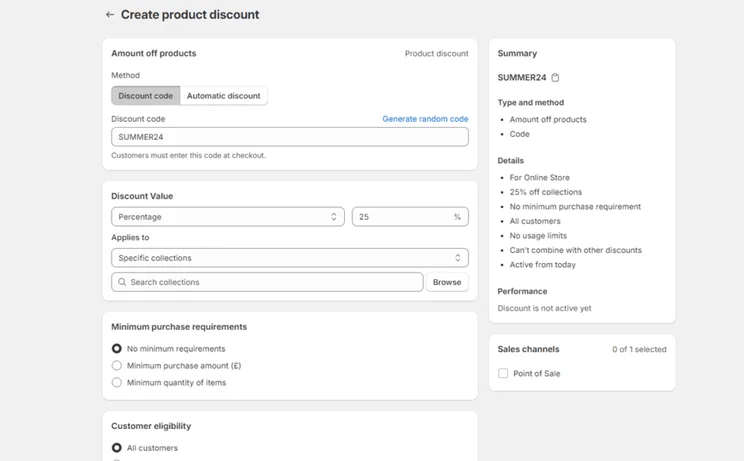
Product discount settings in Shopify
I had the option to create discounts based on a customer’s purchase, the total order amount, or for specific products and collections. Source: Website Builder Expert

Shopify has always been ahead of the game with its AI integration Shopify Magic. This AI tool suite comes with useful features, such as:

  • Shopify Sidekick: an AI-powered assistant that uses your data to help you make smart business decisions and proactively take actions, from customizing your storefront to filling out forms to predicting inventory restocks
  • Theme generation: this tool generates a personalized storefront theme for your business from an AI prompt
  • Text generation: you can generate copy for your store, be it product descriptions, blog posts, or newsletter copy
Quote
💭 Notes from our testers

I found Shopify’s AI assistant so helpful when using the ecommerce builder. I could access it from my dashboard at any time and ask it to analyze my store’s data, give me instructions on how to set up a domain, or generate imagery for my website.

A smiling headshot Holly Choules
Holly Choules Writer

BigCommerce offers a free BigAI Copywriter app to help craft SEO-friendly product descriptions. However, the customization and overall results are limited compared to Shopify’s AI-generated descriptions.
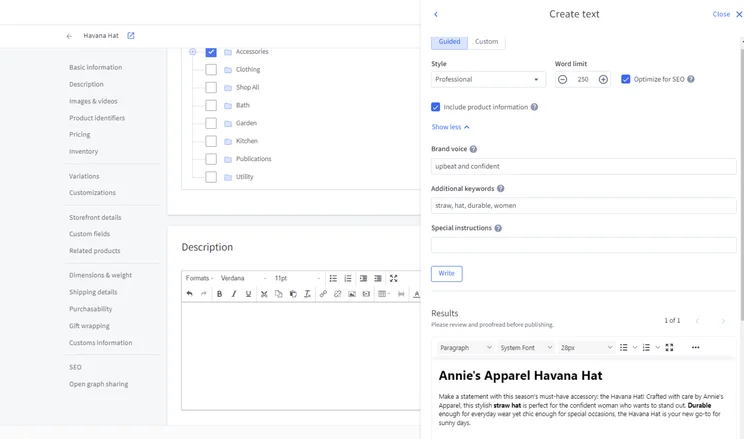
screenshot generating a product description with BigCommerce's BigAI Copywriter app
After I input the style, keywords, and word limit for my copy, BigAI Copywriter quickly provided a strong product description. Source: Website Builder Expert

Payment Options

When testing both builders, I simply had to navigate to my account settings to set up payment options.

To accept payments with Shopify, you must connect to one of over 100 payment methods, including popular options like PayPal, Apple Pay, and Google Pay. You can use multiple payment options at once, giving your customers a choice at checkout.

Alternatively, you can use Shopify Payments, the builder’s native payment gateway, which minimizes transaction fees based on your website subscription. On the cheapest Basic plan, you’ll be charged 2.9% + $0.30 per transaction, but this drops to 2.5% + $0.30 per transaction on the Advanced plan.
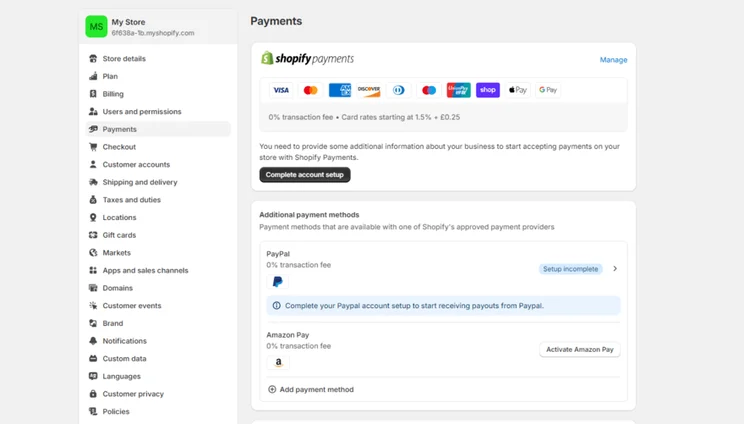
Shopify payments settings
To set up payment options, I went to the “Payments” section in my Shopify settings. Source: Website Builder Expert

In comparison, BigCommerce provides more than 65 payment gateway options, including PayPal and Stripe, but offers no built-in solution. However, a real bonus to consider is that you won’t pay transaction fees on any BigCommerce plan, saving you money in the long run.
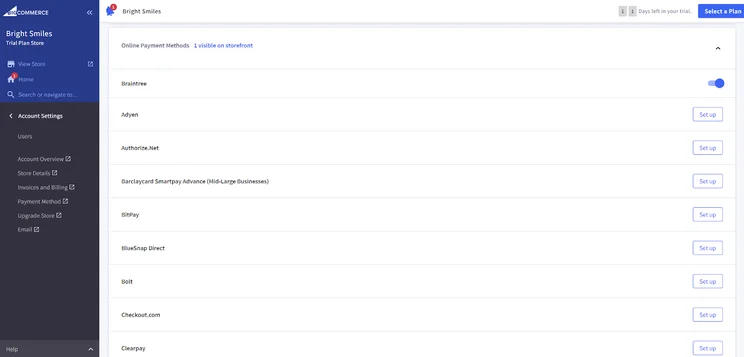
BigCommerce dashboard payment settings showing all the payments gateways that can be set up
I like that all payment options are in one place with BigCommerce. To manage them, just go to the “Payments” tab within the settings. Source: Website Builder Expert

App Market

Shopify’s app market boasts over 8,000 third-party integrations. While this is an impressive number, Shopify relies on these apps to provide you with additional functionality, rather than including these features built into its plans, which would make them more easily available.

Not only does it cost you time to explore the apps to find what you want, but select Shopify apps come with a price tag, so this is an additional cost to consider when setting up your business. Skip to 00:30 in the video below for a tour of Shopify’s app market:

BigCommerce’s app store offers just over 1,200 apps. This said, it has many built-in features – like unlimited staff accounts, product reviews, and real-time shipping quotes – which reduces the need for an app store as impressive as Shopify’s.

BigCommerce’s apps can be filtered by new and popular options, or by business needs such as “Checkout,” “Merchandising,” and “Shipping & Fulfillment.” And, like Shopify, certain apps include premium plans. For example, the ShipStation app costs $9.99 per month on the Starter plan.

Shopify’s app-heavy model is great for businesses that want a highly customized storefront, whereas with BigCommerce, you’ll get a comprehensive array of ecommerce features without having to research apps and pay additional third-party subscription fees.
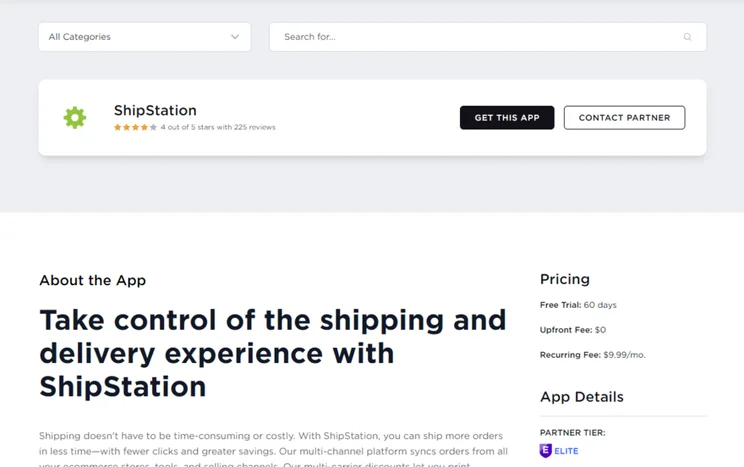
BigCommerce app store showing information and pricing for the app ShipStation
I could view app information and pricing before installing an app from BigCommerce’s app store. Source: Website Builder Expert
The Winner

Shopify has better tools to promote your business and products online

Shopify’s built-in features and large app store make it easy to market your business and connect to other channels for selling, such as TikTok.

While setting up your inventory and prepping your online store for selling is important, none of that matters if you don’t market or promote your business successfully. Customers can’t buy your products if they don’t know they exist. Let’s take a closer look at some key areas for marketing:

Marketing Tools

Shopify offers a ton of useful features to help you engage with customers. You can connect your store with social media platforms, like Instagram and TikTok, or download the Shopify Marketplace Connect app to sell across marketplaces like Amazon and Etsy. This makes it really easy to sync your products across multiple channels.

If you’re interested in email marketing, I could use the Shopify Email feature to build and customize email marketing campaigns from my account.
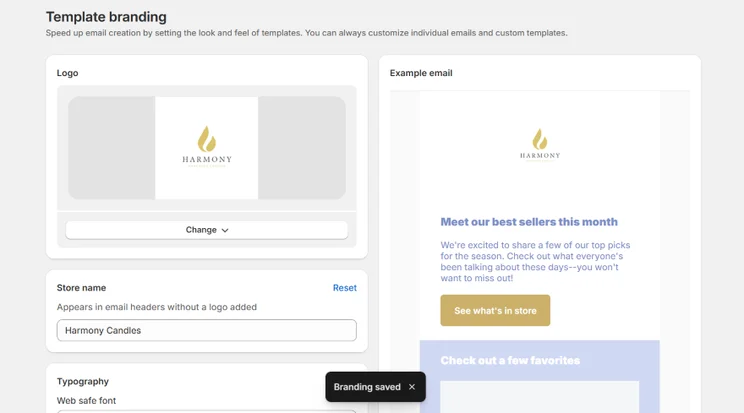
Screenshot of an email editor with logo, header, and colors
I could create a professional email campaign using the Shopify Email editor. Source: Website Builder Expert
Quote
💭 Notes from our testers

Though Shopify Email is a useful tool, it does need a few improvements. During testing, I noticed that Shopify doesn’t pull the branding colors from your website, so customizing your email campaigns does feel like quite a manual process. I needed to add the right colors, fonts, and imagery one by one.

A smiling headshot Holly Choules
Holly Choules Writer

With BigCommerce, I could create promotional banners, set up automated emails (for abandoned carts and purchases), and review my site’s newsletter settings from my dashboard. However, to create personalized email marketing campaigns or connect with social media platforms, I had to download the relevant app.

SEO

Considering Shopify offers so much to help businesses grow, it’s no surprise to see that it excels in our SEO testing. Businesses can expect standard SEO features from both Shopify and BigCommerce, such as sitemaps and image alt text, but Shopify adds a few extras.

For example, Shopify’s Semrush integration helps businesses create a detailed SEO plan to help optimize their websites through actionable recommendations.
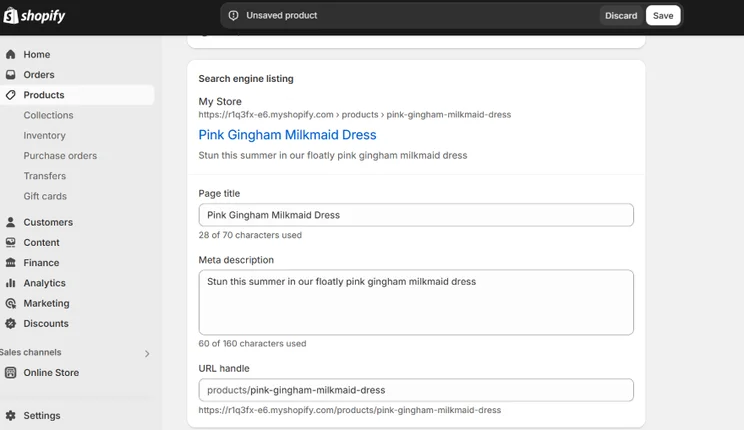
Screenshot of the Shopify dashboard with settings to change item metadata
I could change each product's metadata from the Shopify dashboard. Source: Website Builder Expert

Internationalization

For online stores targeting markets around the world, internationalization features are a must-have. Shopify supports over 30 languages, automatically adapts your storefront to localized currencies, and dynamically translates your site, including product pages and checkouts.

Similarly, BigCommerce’s multi-currency feature allows merchants to display, transact, and settle in multiple currencies. These features make both builders capable of streamlining the shopping experience for global markets.
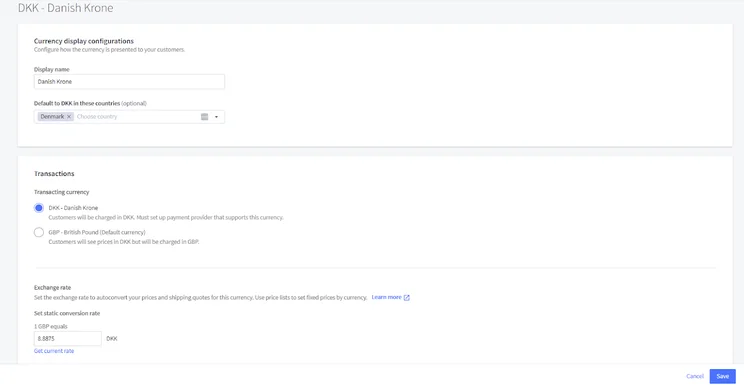
BigCommerce dashboard adding the Danish krone to online store
With BigCommerce, I had control over the exchange rate, the transacting currency, and the countries that would use the currency. Source: Website Builder Expert
The Winner

Shopify’s simple editor is much more user-friendly

Shopify keeps things simple with a quick onboarding process to identify your business needs, a section-based editor, and a robust product backend to manage your inventory.

When testing the two, I found that Shopify offers a more user-friendly experience, whereas BigCommerce’s editor and interface are a little trickier to understand.

My Experience Testing Shopify

When testing Shopify, I was initially asked to describe the state of my business by choosing one of two options: “I’m just starting” or “I’m already selling online or in person.” Other questions included:

  • If you’re a new business, where you’d like to sell (e.g. social media or via an online store)
  • If you’re an established business, where you’re currently selling (e.g. eBay or alternative website builders)
  • What you plan to sell (e.g. products you’ve made, dropshipped items, or services)
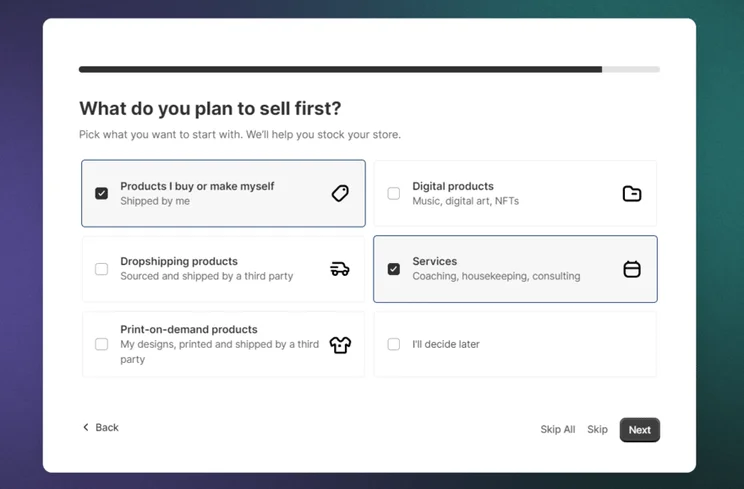
Shopify onboarding question asking "What do you plan to sell first?" with answer boxes to select
Shopify asked me a few onboarding questions to figure out my business needs and goals. Source: Website Builder Expert

My Experience Testing BigCommerce

With BigCommerce, the signup process was a different story. Shopify was easy and took seconds, whereas BigCommerce left me pulling out my hair when trying to access the free trial. Finding the website builder is the first hurdle – you’ll need to click the “Essentials” tab at the top of the homepage.

BigCommerce requires more than just an email address and password to sign up – I had to input my name, phone number, and essential information about my business, like its name and size. This is considerably more detailed than other ecommerce website builders I’ve tested and shouldn’t be necessary for a free trial.

It then took two minutes to process my account and direct me to another onboarding question. This section asked me:

  • Do you have an existing website?
  • What will you be selling?
  • What best describes how you currently sell your products?

While my experience was relatively slow and long-winded, other members of the Website Builder Expert team have had real difficulty accessing BigCommerce’s platform in the past with repeated error messages when trying to log in. So, be warned!

What’s the Next Step After The Onboarding Process?

After onboarding, both builders then present you with your account dashboard. From here, you can add products, start designing your site, or play around with your site’s settings.

BigCommerce and Shopify recommend adding products as your first step, but Shopify’s setup checklist is better for businesses finding their feet online with 13 steps in comparison to BigCommerce’s brief four-step guide.
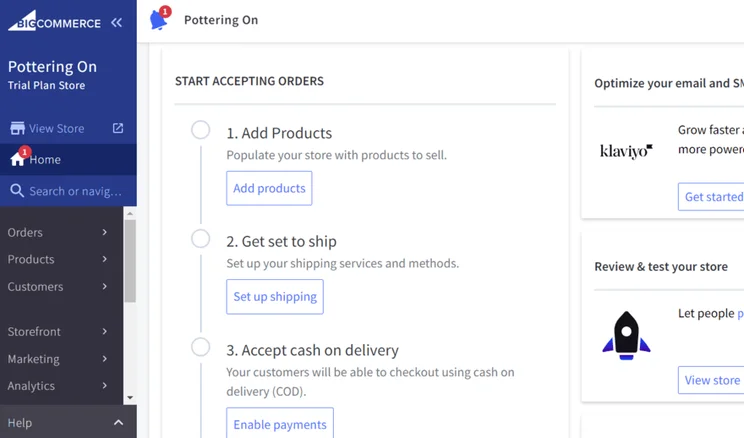
Account dashboard for BigCommerce showing a checklist of steps to accept orders
I found BigCommerce’s account dashboard difficult to navigate. Source: Website Builder Expert
The Winner

Shopify offers a more diverse range of templates for different industries

While Shopify and BigCommerce have similar template libraries and pricing, Shopify’s templates are modern, stylish, and customizable for different business needs.

Your online store needs to make a good impression from the start, which means choosing a beautiful template. For this, I recommend Shopify’s design options over BigCommerce.

Shopify offers more than 200 templates, covering a diverse range of industries and sectors, such as “Pet supplies” and “Jewelry and accessories.” BigCommerce’s template library features a similar number of themes to choose from – these are also categorized by business type.
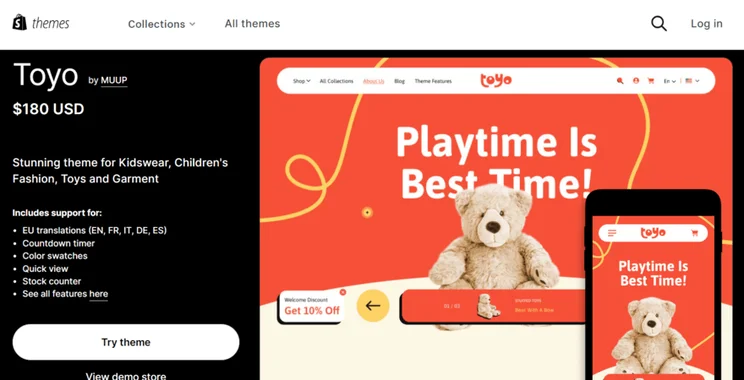
Template preview page with template info for Toyo Shopify template
I could view pricing and supported features when previewing Shopify’s templates. Source: Website Builder Expert

However, both builders offer a limited number of free templates, which isn’t ideal for budget-constrained businesses that are just getting started.

Shopify only has 24 free templates and its premium options range between $100 and $500. BigCommerce only offers 12 free templates and its premium options range between $100 and $400. These template fees are a one-time charge in addition to your website builder subscription.

The Winner

Shopify better supports businesses with 24/7 customer service

You can reach out to Shopify at any time of the day or week through its AI-powered live chat service, or use its detailed Help Center to further your website building knowledge.

Every business needs a helping hand now and again, so I highly recommend checking a website builder’s support options before signing up. This is a great way to assess contact options and reliability – and, luckily, both Shopify and BigCommerce offer 24/7 support channels.

That said, Shopify’s customer service takes the lead in our help and support testing. To fairly compare their help and support options, I’ve collected the key positives and drawbacks of each builder:

Shopify Support

✔️ A 24/7 live chat assistant is available in the Help Center – for complex queries, you can get redirected to a human Support Advisor

✔️ 24/7 phone support is available for Shopify Plus merchants

✔️ You can get in touch with Shopify using social media, including Facebook, X/Twitter, YouTube, Instagram, TikTok, LinkedIn, and Pinterest

✔️ Shopify’s Help Center is very thorough, featuring guides, video tutorials, a community forum, and business courses

❌ Priority support is only given to Shopify Plus customers, so you’ll need to pay more for this enterprise-level plan to skip the queue

❌ Shopify has removed the option to contact its support team via email

❌ I didn’t have lots of guidance when using Shopify’s editor and noticed a lack of tutorials or tours after signing up

BigCommerce Support

✔️ A live chatbot is available 24/7 to answer routine queries

✔️ Phone support is available 24/7 if you’d like to speak directly to the customer service team

✔️ BigCommerce’s Help Center is home to guides, video tutorials, and a community forum

❌ I could fill out a contact form to request email support from BigCommerce’s team but there’s no guarantee of a timely response

❌ Like Shopify, priority support from BigCommerce is only available for industry-leading businesses on a custom enterprise plan

❌ BigCommerce’s setup checklist focuses on selling and didn’t walk me through building or optimizing my website

We regularly review and analyze the best ecommerce website builders using our carefully shaped and rigorous research process. This helps us identify the best platforms to recommend to our readers.

We carried out over 300 hours of testing across seven key areas, which were weighted according to their importance to our readers:

  • Sales Features – 30%
    • We test the ecommerce capabilities of a website builder
  • Website Functionality – 15%
    • We test the quality and quantity of website features available, such as SEO
  • Design Features – 15%
    • We look at templates and design options for online stores
  • Help and Support – 15%
    • We test what support channels and resources are available for businesses
  • User Experience – 10%
    • We make sure to test every ecommerce website builder ourselves to assess its ease of use and accessibility
  • Pricing – 10%
    • We review an ecommerce website builder’s pricing plans to see what you can get for your money
  • Reputation – 5%
    • We look at how customers view each platform and how it performs in comparison to its competitors

Most importantly, I’ve tested both Shopify and BigCommerce myself to make sure the insights and recommendations I share with you are based on real, first-hand experience with both platforms. I’ve included screenshots from my testing throughout this comparison to help you get an idea of what each platform is like to use, and which might be best for you.

For businesses looking to scale their online store, Shopify is the best ecommerce website builder out there. Its sales features were unmatched in our testing, offering impressive tools to help businesses grow.

BigCommerce offers similar features to Shopify, all at the same price points. However, BigCommerce removes transaction fees entirely, making it a cheaper option in the long run. Plus, BigCommerce offers a 15-day free trial, giving entrepreneurs and small businesses a chance to get familiar with the builder ahead of committing to a plan.

While Shopify might be our top choice overall, I recommend giving the two builders a test run with their free trials to see which is the best fit for your business.

Written By

Headshot of Emma Ryan

Emma is Deputy Editor of MVF’s B2B brands, specializing in website builders, ecommerce, marketing, and vibe coding. Emma combines her wealth of knowledge and years of hands-on testing with a passion for helping small businesses and website owners navigate the highs and lows of being online. Her work has been featured in Newsweek, Digiday, TechRound, and Industry Today.

More about

266 comments

Your email address will not be published. Required fields are marked *

  • Paul

    Hi. You state that Shopify has Unlimited Products, however I have just been stopped from uploading anymore products because they say they have recently introduced a storage cap on each plan so I can no longer add any products to my store unless I upgrade to the Advanced plan at a huge premium.

    This is absolutely shocking, as I signed up with them based on the fact that there were unlimited products.

    1 reply

    • Annie Angus
      Annie Angus

      Hi Paul, sorry to hear this! Shopify does allow you to upload as many products as you want, but there are a few things that could be causing your problem. Do you sell digital products? If so, there's a cap on the files size (5GB) and the amount of files you can upload per product. Using third-party apps is a good workaround though, since a lot of them have more generous limits. Also, if you have over 50,000 variants across your store, there a 1,000 limit on how many product variants you can upload per 24 hours.
      I hope this helps!
      Best, Annie

  • Dave

    Definitely Shopify wins for me! I was on Big Commerce for 6 years. Overall I was happy but as my business grew, Big Commerce automatically upgraded me from the plus plan at $75 month to the pro plan at $299 month - then when my sales surpassed their thresholds, they continued to raise my fees until I was paying $600/month (not including apps).
    I felt this was akin to owning a brick and mortar store and your landlord raising your rent whenever he saw your store doing well.
    For me, this was very frustrating, since my business is dropship and my profit margins are slim - so even though my gross sales appeared good, the $600/month cut significantly into my net.
    My biggest problem was that my business is seasonal and during the off seasons, when my sales were much lower, I was still locked into the $600 month fees because Big Commerce bases this on the last 12 month averages. These fees were killing me during my off season and Big Commerce wasn't willing to do anything about it, so I finally switched to Shopify and I couldn't be happier. Their fees stay the same regardless of your sales. I’m now paying $948/year for Shopify & $65/month for apps - all totaled, a savings of approx $6,000/year!!! - for essentially the exact same thing.
    Aside from the fees, I'm also really happy with how easy Shopify is. All my apps seem to integrate better and everything runs smoother.

    1 reply

    • Emma Ryan
      Emma Ryan

      Hi Dave,
      Thanks for commenting and sharing your story with BigCommerce and Shopify with us. We have to agree, Shopify is a great choice for online stores! We're pleased to hear you've had a positive experience with the builder.
      Very best,
      Emma

  • Gina

    I have a Big Commerce site. Big Commerce tech support is hands down better than Shopify. I must have called them 20 times the first week I was building my store and each and every person that I spoke with was kind and patient. They always fixed whatever issue I had. Big Commerce comes included with apps that Shopify charges extra for. Big Commerce has tons of online help for example, Live Chat, The Big Commerce University, Ask the Community and of course 24/7 phone support. There is more of a learning curve but well worth it for what you get in return.

    1 reply

    • Lucy Carney
      Lucy Carney

      Hi Gina,
      Thanks so much for your comment, and for sharing your experience with BigCommerce's help and support! I'm so happy that you had such a positive experience with BigCommerce's support team, and I'm sure our other readers will find it a really useful insight too while they decide which platform to use.
      Thanks again for sharing, have a great day!
      Lucy

  • Cris

    Excellent overview, thank you!

  • Don

    Good article. the only limitation that forced us off Shopify was the limit of 100 variants per product. We have three key options on all our products, one has 16 variations, another 4 and another 5 for a total of 320 variants per product. Otherwise Shopify worked fine and could recommend if more than 100 variant combinations per product not needed.

    1 reply

    • Ben

      I have the same issue with my store. I've considered migrating from BigCommerce to Shopify, but I don't think Shopify could handle the products we sell that have a large range of options. On the other hand, for those who have limited options, building the product options is a whole lot faster and easier using Shopify.

  • Troy

    We are evaluating Shopify and BigCommerce. We have a home grown back-end database of our catalog,orders, etc. We manage our various suppliers and marketplace sales in our own system and would like a storefront that will behave more like a marketplace from the standpoint of integration. i.e. We want to be able to provide feeds or use apis to mass update our catalog from our backend database. We want to hourly sync sales from various marketplaces, along with frequent daily updates to stock, pricing, and shipping. Shopify seems to be sorely lacking in the ability to bulk update. It seems there is a CSV manual import that is available, but no way to automate this or use the api in bulk. 2 - 4 product updates per second for instance on a 250,000 product catalog would take over a day to update fully. BigCommerce has a 10 product bulk update feature, and has less limitations on single api update calls, but it still seems they are both lacking in simple bulk updates for products, pricing, inventory, and shipping. We want a solution that is proven, mobile and future ready... but don't want to have the maintenance of up keeping a self hosted and or designed solution. Where should we look next?

    1 reply

    • Maura Monaghan
      Maura Monaghan

      Hi Troy,
      Although most ecommerce website builders can't completely automate catalog updates, I'd recommend Volusion as a last resort if you've already tried Shopify and BigCommerce. It's not as easy to use, because it relies a little more on code, but that means you can make bulk updates to inventory by changing a certain value or text string in one product listing, and then applying that change to as many records as you need to. It's not ideal, but it is a pretty streamlined process. I hope this helps!
      Maura

  • Sofia M.

    Thanks for the useful article! In the world of ecommerce, BigCommerce and Shopify are the 2 powerful leading platform. Personally, I used Shopify and want to migrate my store to another platform, and I transferred all the data to the BigCommerce by using an automated shopping cart migration tool called LitExtension. The reason why I choose BigCommerce is its themes which are better than Shopify!

  • Stefanie

    Awesome comparison!

    I think that shopify is much better choice, because it's easier to use and has much more functions. Shopify has apps that bigcommerce doesn't, like TRAFFIC APPS or LANDING PAGE OPTIMIZATION APPS.

    Also, shopify support is way better than bigcommerce, fast response 24/7, so, if you have any problems, you can fix them really fast.

  • Shikha Rana

    Great in-depth review. Very helpful. Thank you!

  • Elna

    Thanks for the article.
    which one between shopify and bigcommerce can accept payment in currency of Indonesia and with debit card?

    1 reply

  • Debbie D

    Hi - I am looking to build a website and then sell on Pinterest, Instagram and Facebook. Would BigCommerce or Shopify be better for these specific platforms?

    1 reply

    • Natasha Willett
      Natasha Willett

      Hi Debbie,
      Cheers for the great question. With both BigCommerce and Shopify allowing you to sell on all three social media platforms, I don't think either or would be better than the other in this respect. Shopify do however support other social media channels such as buzzfeed for example, they also with Facebook allow you to sell through Facebook messenger not just through your business page which is a real personal touch when selling through social media.
      Have you seen our how to sell on Instagram or Facebook articles, these may help you make the decision over which builder to use.
      All the best with your difficult decision, do let us know which one you decided to go with.
      Natasha.

  • laura

    Thanks for the article. I wish you would compare multi-channel selling on each platform. This is what's holding me back.

    It seems like BigCommerce offers multi-channel out of the box to Ebay, Amazon, pinterest, facebook, etc. Whereas with Shopify, you have to purchase fairly expensive apps to deal with this.

    My concerns are ease of integration with other venues. How easy is it to copy existing listings over to BigCommerce/Shopify from Ebay or Amazon? How easy it is to set the system up?

    I'm concerned about the reliability of the synchronization. Ebay is very strict and punitive if sellers do not meet their obligations so if the platform's servers go down or they have frequent periods of sync not working, this could create huge problems for sellers.

    Last, with BigCommerce, they are beginning to recommend using Inkfrog to connect with Ebay due to Ebay's new product-based shopping experience that is rolling out. Is the same true for Shopify, I wonder? If that is the case, am I better off without a store and just using Inkfrog?

    These issues really have me stuck.

    1 reply

    • Natasha Willett
      Natasha Willett

      Hi Laura,
      Thank you for the comment. That's a really good suggestion cheers. We are currently reviewing all the ecommerce builders and one of the areas of investigation is actually multi-channel integration.

      You are absolutely right, BigCommerce offer in-built integration whereas Shopify generally rely on third party plug ins. If you are looking at BigCommerce the process could not be easier, check out this article ,all you'll have to do is head into the channel manager and click on the relevant icon that you want to set up, add the relevant account details and away you go.

      Personally, I have not heard of any reason to doubt BigCommerce when it comes to synchronization or servers going down, they really do pride themselves for their customer service and should there ever be an issue they are always on hand to help you whether through live chat, phone or email.

      BigCommerce actually have a great offer running at the moment of 3 free months of eBay premium store, allowing for up to 1,000 fee listings, lower final value fees and an easy to create branded store experience - all of this you would not get through Inkfrog. The great thing about having the feature inbuilt is that all the analytics falls into one place whereas with Inkfrog, your sales through eBay will be placed separately. If you are only looking to sell through eBay / Amazon and not through a website then potentially Inkfrog is a good option for you, just be mindful that building your brand comes easy with a website of your own as it does give you more control over your brand image, with Amazon and eBday providing limited product page looks for example.

      I hope this all helps,
      Natasha.

  • Kashyap Trivedi

    Really great article. Personally, I have used BigCommerce theme from PSDCenter for my store, and in terms of themes, BigCommerce is better than Shopify!

    1 reply

    • Fred Isaac
      Fred Isaac

      Thanks Kashyap, good luck with your ecommerce store!

  • Scott Ginsberg

    Awesome topic, glad we’re talking about it.

    There are some instances where Shopify is not recommended.

    Does your ecommerce store need mass customization? Is there a highly specific flow you’re looking for? If so, there may be limits on what you can do within that particular platform.

    A smarter provider in this sense would be BigCommerce, which is a powerful ecommerce platform for fast-growing and mid-market brands. A somewhat newer player in the space, BigCommerce is more affordable than Magento and offers advanced functionality and flexibility at no additional cost.

    Good luck!

  • Matt Rock

    Great in-depth review. Very helpful. Thank you!

    1 reply

    • Fred Isaac
      Fred Isaac

      Thanks for the comment Matt - hope you picked a winner for you!

  • Danyal

    aweaome explanation brother thanks

    1 reply

    • Fred Isaac
      Fred Isaac

      Great to hear you found it useful, thanks Danyal!

  • Dean

    One of best comparisons. Thanks.

    1 reply

    • Fred Isaac
      Fred Isaac

      Thanks Dean, hope it helped you make an informed decision about which builder to go with.

  • Bernie Perry

    Thanks for this and the several other articles you've created to help folks compare Shopify and BigCommerce.

    Can you point me to any resources that delineate the specific tools that BigCommerce includes "out of the box" that we would most likely have to purchase equivalents as third-party plugins if we went with Shopify?

    Thanks ... Bernie

    1 reply

    • Adelle Kehoe
      Adelle Kehoe

      Hi Bernie,

      Great question! As you may have found, that list doesn’t actually exist anywhere at the moment. However, there’s a way around this.

      If you can think about the tools and ‘out of the box’ features that would be relevant to your site. Check if they’re in the BigCommerce feature list first. You can then find out if Shopify have them via their live chat function - it’s no effort at all.

      So get that list ready and fire it away to Shopify and question them to your heart’s content! Each store is different, so it’s important you find the best provider before building. Good luck!

  • Mireille Coolen

    Hi Jeremy and team,

    Thank you for your insightful article.

    Surely, we have not started out our business but I cannot wrap my head around some of information. Firstly, do both BC and Shopify charge in US? We live in Australia so it will be helpful if we get charged in AUD.

    Regarding the thresholds of BC, does it mean that once we reach 50K in the financial year, we automatically will be built the higher package every month following? Are we able to downgrade also should potential sales drop?

    Lastly.. our store will not be a typical retail store but also with repairs and RMA's. I was looking at Shopify but it does not seem to offer an option to return the stock and track it's status of repairs etc.. It might be a bit specific but we do need this option. Would you know if there is such option available on both platforms?

    Many thanks for any assistance you may offer.

    Mireille

    1 reply

    • Fred Isaac
      Fred Isaac

      Hi Mireille, both Shopify and BigCommerce offer currency conversion options, so charging in AUD shouldn't be a problem. Our in-depth BigCommerce pricing review should be able to answer your questions - https://www.websitebuilderexpert.com/bigcommerce-pricing/. Hope this helps!

  • Alan Kerner

    Thank you... very informative research and helpful to me.

  • Abu Aliyah

    Its shopify complete victory for me. Why ? Because they have app for shipping in my country indonesia.

    Manual pricing for shipping is not suitable for me. Because we have so many city and island with different shipping cost. From $0.7 USD - $10 USD per kg .

    I know some big successful store here use shopify. But i dont know anyone here who use bigcommerce

    1 reply

    • Tom Watts
      Tom Watts

      Hi Abu,

      Thanks for your insights!

      It's definitely interesting to hear how different factors can make or break a builder's popularity around the globe.

      Best of luck with your store + thanks for reading,
      - Tom

  • Omer

    Really informative topic, Thaks

    1 reply

    • Tom Watts
      Tom Watts

      Hello Omer,

      Good to hear you found the discussion helpful!

      Feel free to share if you think others might benefit too.

      Thanks for reading
      - Tom

  • Eve Moriarty

    Hi! Thanks for this great review of these 2 ecommerce platforms. I own a small brick & mortar gift shop...literally Main Street, USA and feeling the pressure to convert to an online enterprise...I use Shopkeep for my POS; they have partnered with Bigcommerce, which would mean I wouldn't have to change the way I process cc payments or have to upload my entire inventory onto a new platform so it would be a huge time saver to just go with Bigcommerce. But...Shopify looks real enticing! Hmm...choices, choices...
    I was hoping you could discuss/compare bandwidths of these 2 companies...
    Thanks...Eve Moriarty

    1 reply

    • Tom Watts
      Tom Watts

      Hi Eve,

      I know both platforms are probably looking pretty enticing to you right now, and the fact your cc processor is already integrated with BigCommerce is just another big tick in that column!

      As for a bandwidth comparison, both offer you unlimited bandwidth across all of their plans! Very generous, I'm sure you'll agree and hopefully one more concern checked off.

      If you're new to ecommerce, then the key things to think about are how quickly and easily you can get set up, whether you can accept payments or not, and the quality of design available to you.

      For me, I prefer Shopify as I find a little more intuitive to use and think it generally has nicer templates than BigCommerce does - but each to their own.

      I've linked to our dedicated reviews of each platform, which should give you some food for thought.

      - Tom

  • Patrick

    Thanks for your article.
    I had a funny reason to i stop with Shopify. I'm leaving in Asia and doesn't have a credit card only a debit card.
    So i cannot pay the fees as they accept only credit card as system of payment.
    Doesn't look very professional for a big e-business company.

    1 reply

    • Tom Watts
      Tom Watts

      Hello Patrick,

      I agree that it is frustrating that you can't use your debit card to pay for Shopify's fees and hopefully this will change one day.

      Shopify is slowly but surely expanding it's global presence, which you can see by comparing the number of payment gateways and available payment methods in the US, Europe and Asia. As we move further from Shopify's American base of operations the service offering is slightly less each time.

      Another reason for the credit cards only policy is that they are generally much safer and trustworthy than debit card transactions as they are treated differently under consumer protection laws. Credit cards can limit fraudulent transactions and protect your money much more effectively than debit cards.

      So, I think Shopify are covering themselves and their customers by only accepting credit cards at this time.

      Hope that clarifies things a bit,
      - Tom

  • john

    Great info. It seems like Shopify has a biiger presence on Ebay. Maybe its the advertising. I was hoping to gleam some info on drop shipping comparisons between both. Any suggestions of where I can get that. Thanks In Advance.

    1 reply

    • Tom Watts
      Tom Watts

      Hi john,

      Thanks for reading and it's good to hear the discussion proved useful for you.

      In my experience, I've found Shopify to be the slightly better choice for dropshippers as Amazon and a whole host of other partners are easily accessible through the platform.

      That's not to say BigCommerce is a bad choice for dropshipping, but Amazon isn't natively supported so you would need to integrate third party apps to enable it.

      It's worth poking around both app stores (which I've linked to for you) and see which is more aligned to your specific needs.

      Hope that helps,
      - Tom

  • Mr. Skip

    OMG - Thanks sooo much! Been a Graphic Designer since the 70s. Just beginning to try to turn some of those dormant ideas into cash.

    1 reply

    • Tom Watts
      Tom Watts

      Nice one Mr. Skip - glad it proved useful!

      Thanks for reading,
      - Tom

  • Hans

    I understand BigCommerce nor Shopify is available on continental Europe. Any recommendations regarding players that ARE supporting that territory?

    1 reply

    • Tom Watts
      Tom Watts

      Hi Hans,

      I'm not quite sure where you heard this but I can confirm that there aren't any restrictions on running an ecommerce store on either Shopify or BigCommerce if you are based in central Europe.

      You may find restrictions on accepting payments from certain countries, but these will be listed on the Shopify and BigCommerce websites respectively.

      - Tom

  • Bud

    Great article,I have invested dollars in shop and was doing research on Big C,you contrasted the 2 companies as well as one could. Thanks

    1 reply

    • Tom Watts
      Tom Watts

      No problem Bud,

      Good to hear you found the discussion useful - best of luck with your store.

      Feel free to share this discussion if you think others will find it handy too, just use the social buttons above. We always appreciate it!

      Thanks for reading,
      - Tom

  • YT

    Hi, Jeremy

    Big thanks for posting great reviews. Your posts helped us make the right decisions years ago on a different startup and I am glad that you guys are still in the space!

    I have read tons of articles but will appreciate your help on the following questions -

    1. Can thrive and bigcommerce be working together on wordpress?
    2. Since our sales all happened outside shopify, and what we need are a number of squeeze pages for "list building and creating sales funnels. However we still want to run our own ecommerce site in 3-6 months when we have time to maintain and run it.

    Does it make sense to switch to wordpress for now? or keep shopify ? so we don't need to keep learning the new tools..

    1 reply

    • Tom Watts
      Tom Watts

      Hi YT,

      Thanks for the great feedback, always appreciated. It's great to hear you're still reading our content.

      I've never used Bigcommerce in conjunction with a Thrive WordPress theme, so I wouldn't be able to say. The best bet would be to contact the Thrive development team and ask them if this is possible or not.

      Going on the information you've provided, if none of your sales came through Shopify then there should be minimal financial impact if you start working on the WordPress website alongside your Shopify Store. If you are just using Shopify for the landing pages, then there shouldn't be an issue if you let them collect information for you while you develop your WordPress site and improve your skills.

      Hope that helps,
      - Tom

  • Errol

    What an excellent article! Very detailed, informative, and helpful. Fantastic work Mr Jeremy Wong.

  • Andreea Popescu

    Hi!
    Thank you for this article. I actually have an online shop with BigCommerce right now and I am thinking about migration because BigCommerce just pissed me off.
    My country doesn't use english as first language so I have to translate everything in my BigCommerce website. This wouldn't be hard if I wouldn't need a programmer for EVERY THING in my website. It's even harder because most of the themes cannot be translated.
    I need a programmer for the slightest thing in my website, it's like I can't do anything but to upload products, categories, follow orders and some basic stuff there.

    I hope that maybe Shopify is more flexible.

    1 reply

    • Tom Watts
      Tom Watts

      Hi Andreea,

      Sorry to hear you've had some trouble with BigCommerce.

      It sounds like you may need to change the language settings on your account, which should prevent the need to translate everything. Just head to the BigCommerce support site and search 'language'. It should be option number 1.

      Re: themes, I know it can be frustrating if a certain theme that you like isn't localized for your language, but many BigCommerce themes are made by third parties who may not have the time or see the commercial need for translation. It's certainly annoying, I know, but just the way of the world!

      If you're looking for other eCommerce options then Shopify is a good choice as it offers localisation choices for your storefront in its backend and also supports a number of plugins and apps that can improve localisation for your users. We take a closer look in this Shopify review.

      Hope that helps,
      - Tom

  • Renee

    This was great information...Im just starting and Ive never done this before so I need all the information I can get. This article brings a lot of clarity in my search of finding the best resources for my money and business...kudos!!

    1 reply

    • Jeremy
      Jeremy

      Thanks, Renee. Glad you found this comparison guide helpful.

  • Michael De Santis

    Thanks! Well Done!! GBYAA!!! (God Bless You All Always) :-)

  • gautam

    Jeremy This is just excellent. I have a query on transaction fees on big commerce. If I am a small startup and do I need to pay any fees / charges for credit card/debit card/Netbanking transaction to big commerce?

    I have heard that if per month sales exceed $ 50000 then big commerce doesn't charge any transaction fees.

    1 reply

    • Jeremy
      Jeremy

      Hey Gautam,

      With BigCommerce, even though they don't charge you transaction fees, you will still need to pay your payment processor a processing fee. This processing fee is so you can allow your customers to pay you via credit or debit cards. This fee is unavoidable and is not collected by BigCommerce.

      The same goes for Shopify. Even if you use Shopify Payments and have your transaction fees waived (charged by Shopify), you will still need to pay a payment processing fee to your payment processor. This fee is not collected by Shopify.

      Hope this clarifies things.

      Jeremy

      1 reply

      • gautam

        Thanks a lot Jeremy. It is now clear.
        I would like to build my own eCommerce Art store. I need some custom features like display painting on the wall, Rating on different art parameters etc. I won't find these features as built in in any ecommerce platform. Would you suggest any platform for the same.

  • Dave Hample

    Jeremy, well done. I wonder if you care to comment on the advantage of Shopify also being able to market a POS system that integrates with their ecommerce platform to help sync inventories.

    1 reply

    • Jeremy
      Jeremy

      Hi Dave,

      We go over some of the advantages in this separate guide. Hope you find it helpful!

      Jeremy

  • Eddie

    It's hard to trust reviews these days, kind of all of them are paid reviews and have bios. This review seems fair and has a lot of good information. But my advise: Please, Avoid Bigcommerce at any price! Customer service is very poor, Integrations are limited, every step is a pain to set up. I've seen my friends using Shopify and it looked, works and integrates way more professional. . Since the day I picked Bigcommerce I regret and hopefully soon I can spend time and migrate to shopify.

  • Terri

    This review is Outstanding! Thank you so much as I have been considering a migration from Bigcommerce to Shopify. This review really helps me keep things into perspective and also helps me see what other advantages I currently have with Bigcommerce. If I ever do make the switch I may not do it until my sales get much higher and more consistent. Thanks again!

    1 reply

    • Jeremy
      Jeremy

      Hi Terri,

      Glad this comparison guide is helpful to you! Best of luck on your ecommerce business.

      Jeremy

  • Alan

    Wow, Jeremy! This is a terrific article. You're a saint to do all this research and then report it. Thank you for publishing such a thorough, impartial analysis. It sounds as if a beginner like me would be most comfortable starting with Shopify. We'll see what happens. I'll report back after I have some time under my belt. Thanks! Alan

    1 reply

    • Jeremy
      Jeremy

      Thanks, Alan! Do share your experiences with us if you get a chance!

      Jeremy

  • Charles

    From seller point of view the key points are not mentioned. Shopify cost you extra to integrate with different sales channels. Bigcommerce does not cost you extra to integrate with ebay, amazon, pinterest and Facebook. But Bigcommerce only support ebay.com. it does not support ebay.can ebay.uk ebay.auto. If you live outside usa. You have to set your main currency as USD dollars, and your own country 2nd. Shopify support royal mail business account, and big commerce doesn't. I think Bigcommerce would offer better value for money for ebay and Amazon sellers if it had international support

    1 reply

    • Jeremy
      Jeremy

      Thanks for sharing your insights, Charles. Very helpful for our readers!

      Jeremy

  • Jeremy
    Jeremy

    Hey Raj,

    I think they do have more discount features (such as volume discount based on how much your shoppers have in the shopping cart) if you are signed up to Shopify Plus.

    They enable you to give either $X off or Y% off to your shoppers under certain conditions (such as if their total shopping balance is higher than certain amount).

    You have a good point, though. I also wish this feature is available for lower plans!

    Jeremy

  • raj

    My choice would have been shopify easily without the second thought but there is big problem with shopify. There is no inbuilt volume discount method on shopify. There is app which cost $16 a month and that also does not work properly. .

  • Excited

    This is a great comprehensive comparison Jeremy as I really didn't know which eCommerce builder to choose. Reading the comments also helped in making a clear choice.
    I would also like to commend you on your patience and the way you tried to answer each comment as sincere and unique as possible even though the majority of your readers were asking and commenting on the same things over and over again.

    ***Read through the comment section first folks and most likely your question has already been answered***

    Great Article!

    1 reply

    • Jeremy
      Jeremy

      Thanks for your feedback and comment!

      The comment section is indeed insightful as it shares a collective view of people's actual experiences.

      But just keep in mind that each user will have his/her own unique set of experiences so it is still prudent to sign up for trial accounts with each ecommerce builder and test them out yourself. Just something to consider!

      Jeremy

  • Vivianna

    Thank you so much for the comprehensive, easy to comprehend, + clear insights, into the daunting world of e-commerce. It helped that I actually went through the entire comparison + will now try both to see which fits me better.

    Every success.

    1 reply

    • Jeremy
      Jeremy

      Thanks Vivianna. I appreciate your feedback!

      Jeremy

  • Jeremy
    Jeremy

    Sharmaine,

    Sorry to hear about your experiences. I suppose if you've made custom changes to your design, then in that specific circumstance, BigCommerce's team won't be able to help you modify the codes. It's sort of like how if you have an "external" mechanic modify your car engine, then the manufacturer can't endorse the warranty if the engine breaks.

    If template selection is important to you, have you considered Shopify? You can see our review of Shopify here. They have a much bigger theme selection and they also have a very healthy group of Shopify Experts that you can hire to help.

    Jeremy

  • Lamar Smith

    Great Job!!! This was fantastic research and article

    Relentless Lamar

  • Jay Scholz

    Great article, Thanks!

    1 reply

    • Jeremy
      Jeremy

      Glad you found our comparison helpful!

  • anne

    Can Shopify or Big Commerce integrate with online selling platforms like Amazon or Ebay?

    1 reply

    • Jeremy
      Jeremy

      Hello Anne,

      BigCommerce fully integrates with Amazon and eBay, so you can publish your products on Amazon and eBay directly from your BigCommerce control panel.

      I don't think Shopify have these integrations yet but I believe they're working on it.

      Jeremy

      1 reply

      • JM Babonneau

        Thanks for your article and research! I missed reading about the shipping deals from both providers and yes, indeed, integration of Amazon and eBay is a big deal changer! But still... the lack of free templates on BC is a deal breaker. Now facebook offers the shop option on its pages too... Hard to choose among options!

        1 reply

        • Jeremy
          Jeremy

          Hi JM,

          Shopify now integrates with Amazon. You can see that feature here.

          Shopify offers a lot more storefront designs than BigCommerce, but I suspect you know about that already!

          Jeremy

  • Max

    Hello, thanks for the post.
    Why didn't you put prestashop also on the compare table?

    1 reply

    • Jeremy
      Jeremy

      Hi Max,

      It's because this guide only compares Shopify and BigCommerce!

      We don't have a review on Prestashop but you'll be able to find plenty online. Sorry!

      Jeremy

  • Blake

    Hi Jeremy,

    Is it just me or has Big Commerce removed the order limits on all of its plans? It used to show it in is pricing structure, but it has since been removed. If so this is a big move right?

    1 reply

    • Jeremy
      Jeremy

      Hey Blake,

      You're right - I don't see it there anymore. It looks like there is still some additional charges under the Pro plan if you sell more than 3,000 orders - an additional $80 for each additional block of 1,000 orders.

      Let me observe this for a few more days and verify with someone at BigCommerce. The previous pricing plan where there were order limitations seemed to be quite unpopular. Perhaps they listened to feedback and altered their pricing structure, which should ultimately benefit merchants!

      Thanks for bringing this up!

      Jeremy

      1 reply

      • Jeremy
        Jeremy

        Hi Blake,

        Actually, the plan is still the same as before. You are still required to upgrade to a higher plan once your online store sales reaches certain threshold.

        They just moved this to the lower part of their "Features" section of their pricing table. When you are on their pricing page, search for "online sales per year" and you'll see it.

        Jeremy

        1 reply

        • John

          I can't see any mention of the 3000 order limit per year any more on their pro plan. Didn't they also have order limits on their smaller plans that they have also removed? It seems their only threshold limits now is the turnover through the site.

          1 reply

          • Jeremy
            Jeremy

            Hi John,

            Thanks for your comment. BigCommerce recently updated their plan offerings and now you are not subject to order limits. Currently, you only need to upgrade to a higher plan based on your sales threshold on a trailing 12 month basis.

            Jeremy

            1 reply

            • John

              I have just looked again, and it appears the 3000 limit is hidden behind an 'i' at the top where it says 'starting at...'. So if you hover on the i, it will show the order limits and pricing for additional 1000 order block. So it looks like it still applies, it is just not as clearly shown as it was. I missed it the first time.

              1 reply

              • Jeremy
                Jeremy

                Thanks for pointing that out. That "footnote" was more visible just a couple of months ago. You can see it listed out in our pricing table screenshot in our discussion above.

                This "limitation" only starts to apply when your business grows int a certain size where you need the Pro plan to support it. But it's definitely worth noting before you commit to them.

                Thanks for adding to this discussion!

                Jeremy

  • Angela

    This is an awesome post! I did the free trial for BigCommerce & Shopify and I couldn't decide which one I preferred. Now I changed from Shoppingcartsplus which is $30.00 monthly with unlimited products and 10 days free trial. After being with them for a long time I felt that I was just wasting my money and time and not getting much sales as needed. I decided to change to Big Cartel basic for $9.99 with 25 products offered. I choose that plan to see how it works before I upgrade to the $19.99 for 100 products.

    After reading this post I'm contemplating whether I should change to Shopify.

    1 reply

    • Jeremy
      Jeremy

      Hi Angela,

      Thanks for your comment. Sometimes it just takes a few tries to find the right ecommerce website builder. It's all part of the process! Sounds like you're moving in the right direction. Good luck!

      Jeremy

  • Raj Sharma

    Hi Jeremy! This is an amazing article!

    I had a query. A friend & I are going live with our start-up later this year. We are a transport/cargo industry based company, similar to a FedEx.

    On the face of it, Shopify seems capable of building a website for this purpose. However, I am not 100% sure.
    What e-commerce solution would you recommend for us based on the industry we are looking to enter?

    1 reply

    • Jeremy
      Jeremy

      Hello Raj,

      I'm not entirely sure which website builder will be ideal for the shipping industry. It's not exactly a "typical" industry that most people get into!

      The first thing you need to do is figure out what non-typical tools you need. For instance, if you want to just build pages with descriptions, prices, just basic things, then most website builders can handle that without any issues.

      But if you want a tracking tool, like what FedEx or UPS offers on their websites, then I think you might need to have something custom built as I don't think Shopify nor BigCommerce offers this sort of tool.

      If you have specific tools you need, you can always search through Shopify's support portal or their App Store to see if they offer those.

      Hope this points you in the right direction.

      Jeremy

  • Steve Olson

    We were on Bigcommerce since 2013 and as you can see by the other comments below - there rates have skyrocketed. We were at $79 one month and then went to almost $300. With the rate increase came NO added features. They just decided to raise the rates over 300%. Good for them. We're almost done with our Shopify site and will be migrating over. Once we do, we'll be paying about $100 per month ($79 + $20 for an app).

    1 reply

    • Jeremy
      Jeremy

      Thanks for sharing your experiences with us, Steve.

      Jeremy

  • Chris

    I too have just been stiffed by BIgcommerce.
    I've gone from $39 pcm, to $199pcm, within 3 months, and for NO extra features I need.

    If you have a high turnover and low net profit site, this just does work.

    The pricing structure is based on NOTHING.

    If you are a small business and hit the next level, you're then in the same pricing band as a million dollar turnover business.

    Unreal.

    I'm moving away from BC imminently, as my 3 years to date hold no ground with them,

    VERY disappointed and would not recommend for any business that might do OK in the future!

    1 reply

    • Jeremy
      Jeremy

      Hi Chris,

      Thanks for sharing your experiences with us. Sounds like the BigCommerce pricing structure update really affected you. Sorry to hear about that.

      Which ecommerce builder are you considering migrating to?

      Jeremy

  • scott

    Those who are somewhat successful online should not go with Big Com. We went from $1100 a year ($89 a month) to an astounding and insane $22680.00 dollars a year, no boloney! We were told our price would change as of Sept 1 2016 due to our last years total of having 6785 orders over the previous year.

    The problem with this is that we have only 54 products in total, and Big Com had NOTHING to do with our success. At 54 products we use no bandwidth or much in resources, not have we ever even called their support. Its a very simple operation compared to the companies who are actually Enterprise Level and have a thousand products and use alot of bandwidth. Big Com is a funnel for us, not the factor in our high sales volumes. At over $22,000 a year I find it just insanity, and to not offer a reasonable option is just beyond bizzarre. It's just gouging, they want a piece of our success when they did not help. It was our ads and marketing outside of Big Com that lead to our success.

    I can't explain how gross it feels when a company assume it should get a piece of your pie when they are not directly responsible for it. We would have done well on any platform and would be will to pay a fair amount for the service. I think the 20% of companies that sell well will leave them for sure. Why pay that with all the other good alternative out there.

    1 reply

    • Jeremy
      Jeremy

      Hi Scott,

      First of all congratulations on your success!

      I think the reason behind Bigcommerce's pricing structure is that it does take bandwidth for them to help you process your sales. The structure at quite disadvantageous to high volume, low price produce merchants (as described more fully above).

      So if you sell a lot, and your average selling price across your products is low, then their monthly costs will eat into your margins.

      Take a look at Shopify. If you use Shopify Payments, they will remove all transaction fees so you get to keep more of what you earn even at their lower plans. Keep in mind that there will still be payment processing fees (no way around that).

      Jeremy

      1 reply

      • Andy

        I hear a lot of people complain about BC upping the rate based on order volume, but Shopify does the same thing, just a bite at a time and in my math comes at a much steeper price even at the lowest .5% of sales. And yea Shopify Payment will save some on the surface, but not by enough if you already have a very competitive processor.

        1 reply

        • Jeremy
          Jeremy

          Hey Andy,

          The idea of a transaction fee is to help cover the amount of bandwidth required to power your ecommerce website. So if you have more sales volume, this generally implies more shoppers visiting your website, and the more bandwidth is required to power your store.

          If one uses a website builder that is not hosted (such as WordPress.org), this means the user will have to purchase his/her own hosting services. You can certainly purchase a $5 per month shared hosting but the challenge is that if you get large number of visitors, that level of hosting just won't work well nowadays (people dislike slow loading ecommerce sites and worst yet, such hosting services won't be able to handle a massive flood of visitors such as if you offered a promotion).

          The other alternative is to purchase an upgraded hosting package which is a lot faster (and a lot more expensive), but keep in mind you'll need to manage the technical side of operating your online store.

          With Bigcommerce and Shopify, their hosting is fast, scalable (won't crash if you get a sudden flood of shoppers), and it's all managed for you so you don't have to worry about the technical side of operating an online store.

          So there are pros and cons either way.

          Thanks for adding to this discussion!

          Jeremy

  • Chris

    I am a small business operator with bigcommerce.

    The new pricing for Bigcommerce means I will jump from Paying approx $800 per year to $6,500 per year.

    They actually no longer have a plan suitable for small to medium sized business. Their Pro plan at $2,340 per year only allows you process 8 orders per day before being hit with an additional $80 monthly fee for each additional 2-3 orders per day you may process.

    Thant's it there in black and white. I will get no additional features and need no additional features.

    1 reply

    • Jeremy
      Jeremy

      Hello Chris,

      Thanks for your feedback. The recent Bigcommerce plan structure change does impact some users, especially if you are a high volume seller at a lower price point. Our illustration above under the Pricing section tries to model out / highlight this.

      Having said that, changing over to Shopify (for example) makes sense, but only if you use their Shopify Payment to handle your payment processing function. If not, then you'll have to pay a transaction fee (on top of the payment processing fee) which can also add up if you are enrolled in their lowest plan.

      Hopefully you'll find a suitable solution soon!

      Jeremy

  • Geoff Page

    Thanks for that.
    I currently use Shopify set up here in Australia and linked to two websites. We price our products in AU $ but need to increase our promotions to worldwide markets, particularly USA.
    My problem is that wherever in the world my customer views our site, they only see "$" prices - not their own currency - nor even "AU" $'s and they don't know what their own currency cost is, until checkout.
    That doubtless losses a lot of people before then because they cannot equate value for money when looking at an unfamiliar currency.
    How do the two providers compare when dealing overseas and currency exchanges?

    1 reply

    • Jeremy
      Jeremy

      Hello Geoff,

      Shopify has a tutorial on how to show different currencies in a drop down bar here.

      If you want a more advanced solution, there are a couple of Apps you can check out:

      * Auto Currency Switcher

      * Currency Switcher

      I haven't tried them out before, but definitely worth checking out!

      Jeremy

  • MU

    I have been with BigCommerce for the entire duration of my online business -- nearly five years. I have been happy with them, even though Shopify had consistently offered new features (like buy buttons on Pinterest) before BigCommerce.

    However, the new BigCommerce fee structure is going to bump my pricing plan from $39.99 to $279.99 per month. It appears I can get approximately the same services through Shopify for $79 per month. It'll be a massive pain to switch over, but it'll save me $2,400 per year...possibly more, depending on how quickly my business grows. (The more successful you are on BigCommerce, the more they charge you.)

    I have no idea why on earth BigCommerce has decided that their IPO is more important than losing loyal, long-term customers. Five years from now on Shopify and I could replace the roof on my home with what I'll be saving by switching from BigCommerce. When you are a small business owner, these are the things you think about.

    1 reply

    • Jeremy
      Jeremy

      Hello MU,

      Thanks for sharing your thoughts with us and our readers.

      The change from Bigcommerce is a significant one. In a way, I suppose they have to supplement their fee base since they did remove all transaction fees (they used to charge you a transaction fee per order).

      They indicated that their pricing update only impacted 20% of their customer base, which is quite significant. Of course, each merchant within that 20% group will be affected differently.

      With Shopify, they don't mandate that you fall into any specific plans. So you can stick with their lowest plan and still sell as many products as you can, without having to get bumped up to the next plan.

      I think the main reason this is the case, is that they still require you to pay a transaction fee per sale. However, this is completely removed if you use Shopify Payments to power your shopping cart. That's another way for them to supplement their income. But it's a great idea since as a merchant, you'd have pay a payment processing fee regardless.

      So with Shopify Payment, you effectively have no transaction fee at all.

      At the end of the day, I think that the pricing plans between Shopify and Bigcommerce are quite competitive with one another, except when it comes to the 20% of Bigcommerce users, who I think are high volume sellers with products at lower price points (as highlighted in the article above).

      Thanks for sharing your story with us!

      Jeremy

      1 reply

      • MU

        Jeremy,

        Thanks for the reply. On the topic of transaction fees... I might be mistaken about this, but I'm fairly certain that BigCommerce did away with transaction fees several years ago, when they started using an integrated credit card processor (like Shopify Payment). And just to be clear for anyone reading this (because it was initially confusing to me), there is still a transaction fee from the integrated credit card processing company (3% + $.30), and if customers use PayPal, there is a transaction fee from PayPal (ranges from 2.2% to 2.9% + $.30). No sale is ever without a transaction fee, it just depends who is charging it.

        So I see what you're saying about BigCommerce trying to replace the transaction fees on their end with graduated service plans based on volume of sales, but if it is true that BigCommerce has not charged transaction fees for several years, then what it ends up being is a sudden, unexpected increase in cost for many business owners.

        1 reply

        • Jeremy
          Jeremy

          Hi MU,

          Thanks for your follow up. I did highlight the fact that a merchant is still responsible for payment processing fees, and we covered that in our other discussion articles too. But perhaps it is not as pronounced in this article. I'll have a look at it - thanks.

          In regards to Bigcommerce and its transaction fees, I believe they removed it less than 6 months ago. I could be off in terms of the number of months, but they most definitely still charged transaction fees less than a year ago.

          I think this is where they probably caused some sort of confusion for users who signed up with the expectation of no transaction fees.

          Jeremy

  • Waldo Buck

    I've been with Bigcommerce for about a year now and overall have been happy with the pricing, support, and features.

    But with their new pricing model that they just announced, my cost is going from $79 a month to around $350 a month.

    This is truly crazy and their is a big backlash from current customers.

    Now I'm faced with finding a new ecommerce provider and going through the time and expense of customizing a new site.

    Looking at Shopify but am open to other solutions.

    Thanks for having a great site with unbiased information.

  • Maria Gorman

    Bigcommerce is planning a complete change in their pricing structure for 2016, as they prepare for their IPO. They have announced the very drastic changes in a tiny post in their users' forum, accessible only to paying users, and not all of it is clear yet - no transparency here!! In some cases, this will cost existing Bigcommerce users huge price increases, as much as 400% to 800% increase on what they are paying now.

    Many users and partners (experts) are complaining bitterly about the lack of clarity, uncertainty, and sheer insensitivity of these plans, and many users are actively seeking to move to other platforms. The competitors are exploiting the situation and are emailing all BC's users with offers.

    So - your otherwise very helpful review is now out-of-date!! Please update it to reflect this very important development.

    1 reply

    • Jeremy
      Jeremy

      Hi Maria,

      Thanks for the intelligence. As they haven't announced anything publicly yet, I'm a bit hesitant in updating our discussion above based on non-public information, since some of the features and price points are not finalized yet.

      But your comment is very helpful and our readers will hopefully take your observations into consideration.

      Thank you again for taking the time to add to this discussion! Let's wait and see what happens down the road.

      Jeremy

      1 reply

      • Rob

        If you check their plan page they do appear to have just updated them. You will see that the have got rid of transaction fees on their lowest plan, and it now has a 50k sales volume per year on that plan. Their Pro plan now has $125k sales volume per year. I don't think these are discussed in your comparison.

        1 reply

        • Jeremy
          Jeremy

          Hi Rob,

          The sales volume is just a guidance as to which plan may potentially be suitable for users.

          For instance, if one runs a $125,000 sales per year business, and the "Standard" plan features are sufficient, they can use the Standard plan instead of the Plus plan.

          So it's just a rough guidance. The other way is true as well. If your business need more tools, but are below $100,000 in annual revenues, then the Plus plan may be more suitable.

          Jeremy

          1 reply

          • Joe

            Great article but out of date. You need to contact Bigcommerce and get access to their forum to read the thread which is 27 pages long...tons of merchants are angry. If they refuse to show you this hidden thread you need to interview merchants for your this analysis because, imo, your analysis is now WAY out of date.

            1 reply

            • Jeremy
              Jeremy

              Hi Joe,

              Sounds like it! If you have the link to the forum thread handy, please do send it to me at at info [at] websitebuilderexpert [dot] com

              Would love to get to the bottom of this.

              But again, I would be a bit cautious in updating this comparison before Bigcommerce officially releases their position on pricing. They could be just soliciting feedback at the moment.

              But all very interesting!

              Jeremy

  • Diana G

    Thank you for taking the time to put together this great review. Very comprehensive and helpful. I've been looking at Shopify and BigCommerce and something I didn't realize until this afternoon is that with Shopify's $29 Basic Plan there are no reporting tools for your store. You need Shopify's Pro Plan at $79 to access reporting.

    BigCommerce includes reporting with their Standard package at $29.95. I was really surprised by that and don't understand why Shopify doesn't include reports in their basic version. I called Shopify support today to double check and they confirmed that reporting becomes available with their Pro plan.

    Also learned that Shopify's basic plan doesn't include access to abandoned cart information. The BigCommerce Standard Plan will provide abandoned cart information (how many items are left). BigCommerce offers specifics on items left in cart/customer email in their Plus plan @$79.95 a month.

    1 reply

    • Jeremy
      Jeremy

      Hi Diana,

      Thanks for sharing your findings. I didn't know that Bigcommerce provides abandoned cart recovery tool for their Standard Plan. I just looked at their pricing plan and looks like this feature is only offered in their Plus plans.

      Are you saying that Bigcommerce will be offering this feature for their Standard plan soon?

      Jeremy

  • Ryan @ WebEminence

    Nice overview, Jeremy. I have a lot of experience with Shopify and my Shopify vid on Youtube gets a lot of view so I thought I'd do a review on BigCommerce as well. I just started poking around in a BigCommerce account for about 30 minutes. First impressions - BigCommerce offers a lot more options for products. Shopify has about 15 fields you fill for products and BigCommerce has 30+!

    The 1.5% transaction fee on the lower plan might be tough to swallow for a lot of shops just getting started. But I could see a lot of established sellers going right to the $79 Plus plan and that not being an option.

    I wonder why Shopify has such faster growth in Google trends. Interesting....They seem to have much better PR and exposure. They also have some nice Google rankings for some huge keywords. That may be the difference.

    Thanks again for the thorough review. I'll probably be referring back to it as I go through my own comparison.

    1 reply

    • Jeremy
      Jeremy

      Hey Ryan,

      Thanks for your comment and I like what you're doing over at your website!

      Glad you found our discussions here helpful as well.

      Regarding Shopify, I think they're definitely doing a much better job in branding their platform. They run an annual "Build a Business Competition" and has big names such as Richard Branson, Daymond John, etc endorsing it, which gives it a lot of publicity. Further, Shopify is a publicly traded company which gives it more visibility as well.

      Jeremy

  • Renee Wood

    I've tried both trials for Shopify and Bigcommerce. My biggest reason for not selecting Shopify is that they lack the ability to input product dimensions on the shipping pages. Now that dimensional weights are being used by UPS and USPS, this is so important when pulling real time shipping charges. Shopify only allows you to select one box size for all products. Unless I am understanding this incorrectly? But I did contact a guru and they agreed it was true.

    Anyone have any thoughts?

    1 reply

    • Jeremy
      Jeremy

      Hi Renee,

      I don't think Shopify gives you the option to have different dimensions for products, but you can certainly have different sizes (such as small / medium / large t-shirts or whatever product you have). So essentially this is possible.

      As for shipping rates, they do offer you real time shipping rates calculator if you sign up to Shopify's Unlimited Plan.

      You can also check out their App Store and look at some shipping apps created by other service providers. Some are pretty powerful but some of them do charge a monthly plan for you to use them. So if they do suit your needs, you can consider if you want to sign up or not.

      Jeremy

  • michelle

    Does Magento have an app to sell on Pinterest?

    1 reply

    • Jeremy
      Jeremy

      Not that I know of. I think only Shopify has buyable pins at the moment.

  • michelle

    I am finding that Shopify is able to have buyable pins for pinterest. Does Big Commerce have this. Also do you think it will be the same for Instagram?
    Big Commerce keeps telling me they are making it so you can make changes through your phone.
    Still nothing. Can you update with your phone for Shopify?
    Thanks
    M

    1 reply

    • Jeremy
      Jeremy

      Hey Michelle,

      Bigcommerce doesn't have that function yet, to allow people to buy directly on Pinterest. Shopify allows you to integrate your ecommerce website with Pinterest, so Pinterest users can buy directly on Pinterest wthout ever leaving the website.

      As for making updates to your Shopify through your mobile device, they do have that as an option. You can make only certain updates, such as reviewing your order notifications, managing fulfillment of orders, edit your inventory.

      Have a look at this page here and you'll see a bit more what Shopify's app can do for you. There is a short video there too so it will give you a bit more insight on how things work.

      Jeremy

  • Sandra T

    I've been through the e-commerce grinder and back again. I know our website is what is hindering growth and sales. No question in my mind.

    I sell wholesale, and when I looked at Shopify, it was an additional 30 dollars a month to add this app to my store. To not use it meant that I would have to give discount coupons to wholesale customers, but then the taxes are applied to the pre discounted price, not like it is in wholesale. With the Shopify app I found the price breakdowns and bulk discounts were awkward to deal with.

    Not so with Big Commerce, it was a free app and something that wasn't too ugly to wrestle.

    This is a very important consideration for anyone who does more than just retail. VERY important.

    2 replies

    • michelle

      I can't figure out how to do wholesale on Big Commerce. I'm glad you mentioned that b/c it was something I forgot about. I did ask the BC customer support and he had no idea. Disappointed about that. I guess i just need to speak to someone a bit more seasoned

      1 reply

      • Jeremy
        Jeremy

        If you visit Bigcommerce, go to their Support page and type in "Wholesale". You'll then see some help articles on how to create a wholesale store. But note that this feature is only available to Bigcommerce Plus and Enterprise plans.

        With Shopify, as Sandra mentioned above, you will have to add an App to your Shopify store. The "Wholesaler" app is $24 per month.

        Hopefully this points you in the right direction!

        Jeremy

    • Jeremy
      Jeremy

      Thanks for your contribution to this discussion Sandra!

      We've never attempted in running a wholesale business, so this is definitely very helpful knowledge to have.

      Thanks again,

      Jeremy

  • Jeremy
    Jeremy

    Wow thanks for sharing such a comprehensive list Denise! Really adds a lot of value to our discussion here.

    At the end of the day, it's really challenging to find an ecommerce store builder that is "perfect" in every way. Both Shopify and Bigcommerce have improvement points, and I'm sure they both have massive "to improve" lists.

    Based on your store needs, which ecommerce builder did you end up using?

    Jeremy

  • Simon

    Am starting to outgrow BigCommerce.

    Our store is doing about $2million a year in revenue, but we are now looking to ditch and go to Magento on rackspace.

    It's just so hard to extend the functionality. The templating system is a nightmare. The built-in blog is a joke, and customers can't checkout in multiple currencies. At this point we have had to setup two bigcommerce stores, one for USD and the other for AUD.

    Setting up the second store we couldn't migrate any customers, product reviews, or content over...we had to 'hack' and 'trick' the store to do what we want (example, putting through test order where all products were purchased, and then have VA copy and paste the old product reviews over, but ofcourse they now look faked as they have the same date on them all)

    So we send one group of cutomers to one store, and another set to another. This will not be a good long-term solution, especially if we need to add 3/4 stores. What a nightmare for a growing international business.

    The app marketplace is also very lacking, and I feel like the support has been going downhill hard, getting back ridiculous canned responses to issues where customers support hasn't investigated.

    The staff seem apathetic, and they are obviously no longer hiring A-Players as they are growing so fast, they just are putting butts into seats.

    At the start of April our store also went down for 4 days, with nothing but 'sorry guys, it was IBM's fault'

    I havne't played with Shopify that much, but from what I have it has handled several things like Google Shopping feeds etc much better.The marketplace is also more mature, so in all likelihood will do more of what you need as you grow and need to implement more advanced strategies.

    If you are really serious though, I don't see either as a great choice. Chances are you will need to re-platform anyway as you need more and more features.

    1 reply

    • Jeremy
      Jeremy

      Hi Simon,

      First of all, congratulations for building such a successful store! $2m in revenues a year is a huge accomplishment, so congratulations for that.

      Re-platforming can be a pain in the butt, and I guess it is one of those growing pains when your business has outgrown your "home". But I suppose it is a "good" pain as it just means your business is doing well.

      In a weird way I think of it as having a family where the kids are outgrowing the smaller house, and you have to find or build a bigger home. It's a challenge, but at the end of the day it is probably worth the investment.

      Have you considered Shopify Plus? They're an enterprise level platform and based on the size of your business, they might be a good match.

      Given that you are considering "building a new home" for your business anyway, it's worth considering all options.

      Good luck with that!

      Jeremy

  • CT

    We are running Parallax Theme on Shopify and have just received an email notification that there is a new updated version of the Parallax Theme that we should download and install to "enjoy" all the new added features. HOWEVER the instructions say: If you had previously customized your Liquid templates, add all of those tweaks once more to your new theme's Liquid templates. Do the same if you had customized your stylesheets. If you had previously added an app to your store's theme, you will need to uninstall the apps, and reinstall the apps from our App store.

    Well I don't know about you - but I am not about to recode and reconfigure my whole store and pay a programmer once again to code and install my apps in order to update the theme....don't know what they're thinking!!

    CT

    1 reply

    • Jeremy
      Jeremy

      Hey CT,

      Sorry to hear about your situation. I think this is one of those classic challenges of building online properties / websites, especially when making code modifications to your theme. Any major updates may result in you having to install the entire theme again, which will re-set your code edits.

      I think this is where WordPress does a slightly better job in that their infrastructure allows you to have get updates without having to re-install themes or plugins. Having said that, even for WordPress, sometimes updates will "break" your website due to customizations you may have done to your website, or the updates will conflict with other plugins on your site.

      I guess what I'm saying is that even for leading website building platforms such as WordPress, these sort of challenges will still exist.

      One option is that if the update is not significant, you won't necessarily have to use it. But if it is a much more serious update, such as Shopify making platform changes and the theme must be updated, then you won't have that option.

      I understand your frustration CT - I really do as that happened to us a few times too! But it's one of those maintenance things that just happens when one is building a website / online store. Operating an ecommerce website is not that much different than running a physical store - there are a lot of maintenance / upkeep work!

      Jeremy

  • Abbie

    Interesting article.No doubt both are best platforms for building eCommerce website.Both of the platforms are great but I would love to work with Shopify.I really like its theme's designs, they are impressive and attractive too.

    1 reply

    • Jeremy
      Jeremy

      Thanks for your comment Abbie.

      One thing I think Shopify does very well is that they really pay attention to growing their "ecosystem". Basically building partnerships with professional theme designers / developers, app developers, etc.

      So they're very good with leveraging off other people's expertise, which is why their collection of premium themes are very attractive as they're developed by professional designers.

      Jeremy

  • Dmitrii

    Jeremy thank's a lot for this job. It's really helpful.

    If you wanna open the website with Shopify in Australia, you have to pay the commission in any case, because they don't offer in AU and NZ them paying system. So for this region shopify isn't the best choice.

    I like one of bigcommerce premium theme, but I really don't understand what can I change? The theme has just one 5 column line with products (featured, new arrivals or on sale). Can I add on the firts page more columns? Plus 5 rows or more? For example: One row for Featured, one for New arrivals, one for On sale... and all these on the firts page?

    Sorry for this question. Unfortunetely, I'm not in IT industry so for me it's quite complicated:))

    P.S. do you have on your website any reviews about paying programs?

    Thank you.

    1 reply

    • Jeremy
      Jeremy

      Hi Dmitrii,

      I'm not entirely sure how that specific theme works. But generally speaking, if you want a lot of flexibility in terms of design layout, you will need to edit the codes of the template to achieve the exact design that you want.

      You mentioned that you are not in the IT industry so presumably you aren't very proficient with codes? The good thing is that the theme is created by a designer called "Cart Designers" (as per the theme page) so you might be able to reach out to them to see if they can help you modify the theme. Or else Bigcommerce has experts where you can hire to help you get your website set up.

      If you don't want to hire coders to get your site set up (if it's outside of your budget), there are other good drag and drop website builders that offer decent ecommerce functions, such as Wix and Weebly (see our discussions of their ecommerce tools here and here).

      Hope this is helpful.

      Jeremy

  • martin

    Big Commerce is a good starter cart but as your business grows you will very quickly learn it will hold you back.
    In our case it's like steeping over dollars to pick up pennies.
    Over the last year or so I had contacted them with a number of shortcomings, the actual support is great, but they can't help you if the software was not designed for the real commerce in the 1st place.

    Let me give you a gleaming example: Ebay listing option allows you to list ONLY 1 image, yes....you are reading this right. In the image driven world where a picture is worth a thousand words, Big Commerce support told me they had never heard anybody asking for more than one image.
    The worst part about it is, there is no reason for a such a dumb shortcoming.
    So....try to sell clothing, shoes, etc, etc. Big Commerce Ebay feature is useless, this is coming from a provider claiming to make your life easier.

    If you think you can easily use a 3rd party app, think again. It's a mess if you have product options.

    2 replies

    • Mark

      Wow thanks for this. I'm a clothing seller looking to start an ecommerce site. Big Commerce was one of my top potential choices.

      1 reply

      • Jeremy
        Jeremy

        Glad our discussion here is helpful for you Mark!

    • Jeremy
      Jeremy

      Martin - Thanks for sharing your thoughts with us, and adding to this discussion!

      Jeremy

  • Ryan

    Hi Jeremy:

    Thanks for the great, detailed review.

    I'm not sure if this has been mentioned in another comment or if it's a change in their policy, but the Shopify Experts page says setup STARTS at $500.00 (see below).

    From Shopify:

    "What is a Setup Expert?

    Starting at $500, Shopify Setup Experts will help launch your store and assist with basic tasks that can include:

    organizing (and/or importing) your product information, pricing and photos
    selecting one of our beautiful themes
    setting up your site’s structure, homepage and navigation
    helping with basic domains and payments configuration
    training you to operate and maintain your store

    Contact a Setup Expert today to confirm the details of their setup package."

    I hope this is helpful...

    1 reply

    • Jeremy
      Jeremy

      Hey Ryan - you're right. They've updated the plans / pricing structure. I've updated the discussion above to reflect this. Thanks for this!

      Jeremy

  • John

    Maybe it's just me, but it seems like they aren't a great choice if Magento Go is closing down? Doesn't that sort of point to the company failing in general and maybe Magento Community could be next? Seems risky to me.

    1 reply

    • Jeremy
      Jeremy

      Hi John,

      They probably decided to shut down the Magento Go platform so they can focus on other businesses (Magento Enterprise and Magento Community).

      But that may not necessarily mean that the Magento Go platform is not profitable. It could be that their resources are limited and so they decided to allocate more resources into the other 2 platforms as they could be more profitable.

      In any case, one can view that this is extremely positive for Shopify and Bigcommerce, as I think there are still a lot of people who want to build an ecommerce store that's hosted, so they don't have to worry about the technical aspects of building a website.

      Thanks for contributing to this discussion!

      Jeremy

  • John

    At first glance Bigcommerce appears superior to Shopify. Comparing both of their website theme demos I noticed that you can add a blog to your site with Bigcommerce but I don't see that ability with Shopify. By that I mean that you can actually have your store and blog under the same roof, feeding off of the same database, and when you search for something either on the store or the blog, it finds information from the other. I don't see anything like this on Shopify. This is incredibly important and something I don't see being mentioned here. My philosophy is that a blog drives sales and if it's attached to the store it's even more powerful. Good luck to anyone trying to accomplish this with Shopify. It won't happen.

    1 reply

  • Mary Tate

    BigCommerce does not offer over 100 free themes for the website design. I am a paying website owner and there are only at a max of maybe 20 themes available that are free. The rest are over a hundred dollars.

    1 reply

    • Jeremy
      Jeremy

      Hi Mary,

      Thanks for contributing to this discussion here!

      Yes I see what you mean. It looks like Bigcommerce has been reducing their free themes lately, and I suspect / guess the reason is because their older themes are no longer as updated in terms of design. Hopefully what this means is that they are going to introduce more updated themes soon!

      That's one thing I really like about Shopify, is that their themes are a lot better looking than Bigcommerce's themes. Shopify has a bigger selection too!

      Jeremy

  • Raj

    Very informative breakdowns - I wish everything were this laid out : )

    Thanks for your help,

  • Alexis Callaghan

    Thanks for the info. yes it was helpful. I've tried big commerce free trial, so now I'll try shopify.
    Thanks again.

  • Alex ST

    Perfect view and very meaningful for me while I am a new comer in e-store. Thank you for providing these clear and non-partisan reviews!

  • Donna Powell

    This article was thoughtful and well researched. I am a designer who has been building Shopify stores for my clients for almost a year (10+). I have had 100% satisfaction with the Shopify templates, platform & support. When I went to BigCommerce, the inability to view their templates was an instant turn-off, so I am staying with the provider who does not disappoint.

    Charleston Webweaver

  • Anne

    Thank you, thank you! Your article was truely helpful!

    With much appreciation,
    Anne

  • Michel

    Hey Guys,
    your article helped me a lot! Thanks,
    Michel

  • Ameen Moinuddeen

    Hi Jeremy

    Thanks for such a detailed review. It's very kind of you to put in so much effort to guide people who are starting out with ecommerce.

    I would really appreciate if you could clarify one doubt for me please. I am in the process of setting up a ecommerce marketplace (something similar to Etsy but on a smaller scale to begin with). Thus we will be inviting multiple sellers to set up and sell directly from our site.

    So my question is whether any of these leading platforms offer any functionality extensions from their robust directory of apps that will enable me to operate such a business model from their platform.

    Your input would be much appreciated. Thanking you in anticipation

    Kind regards
    Ameen

    1 reply

    • Jeremy
      Jeremy

      Hi Ameen,

      I haven't seen either Shopify or Bigcommerce be able to do this. It sounds like you need some sort of custom solution to create a marketplace type of website.

      Perhaps WordPress can be configured to what you need, but I haven't seen a good example to share with you. Sorry about that.

      - Jeremy

  • David C

    Hi Jeremy,

    Thanks for the great, balanced review. I work for Bigcommerce, and just wanted to give you a heads-up that our support is now available 24/7 via phone, chat and email. We made the change last month to better serve all of our clients outside the US, plus those who work outside normal business hours.

    1 reply

    • Jeremy
      Jeremy

      Hi David,

      Thanks for the heads up! I've now updated the discussion article to reflect this.

      Thanks again!

      - Jeremy

  • Glenn

    I'm not sure if anyone noticed, but I was just browsing between the two sites and noticed that Bigcommerce states they have 24/7 support, including phone. This must be new and an answer to what many were looking for.

    I am helping my girlfriend start up a business selling handmade crafts so we wont need much. I first cringed at the thought of spending $29+ per month for this, especially when I have multiple websites, with hosting that can support more sites (GoDaddy). I was originally thinking of building a typical website and just adding the ecommerce functionality with ZenCart or something similar. but I wasn't sure if that was a good idea to start. I am fairly good with HTML and CSS but I'm not an expert so I wasn't sure how much more would be involved with credit card processing, shipping, etc versus going with a hosted ecommerce builder that has everything put together. I'm thinking maybe just start with the basic Shopify or Bigcommerce plan, see how it goes, and then I can cancel it if I feel confident going with an option that would not cost anything. After all, this is new and we have no idea how much we'll make, but I'm sure we can manage $30 a month lol unless this becomes something very big, I'm sure we could easily justify the costs to make it easy to manage. After all, we are both keeping our full-time jobs as well!

    Any thoughts regarding customization with HTML and CSS? I feel like you mentioned that Bigcommerce may be better for that due to Shopify's proprietary Liquid language. I'm not sure how much of that there is or if it would affect me customizing things, but being that I have my own sites and can code well (Computer Science degree), I'd like to have that functionality. This is where I'm starting to lean towrd Bigcommerce, but I also like that I can just use Shopify Payments and also have better themes to choose from.

    Great information in these reviews by the way. They were helpful, especially this comparison. I'll definitely be doing some more digging and looking into both trials.

  • Jeff Rayhorn

    I have looked at both Shopify & Bigcommerce, and decided to go with BC.
    My business is a "service provider" type where you purchase coupons for discounted services to different vendors, so we actually have no physical inventory and therefore no need for shipping/tax options. The problem is that there is no way to turn off these functions - unless you hire a 3rd party & pay for a good deal of customization. They don't even have a way to customize the order confirmation email to include a link back to the item you purchased.
    Does anyone know of an eCommerce solution that caters to this kind of business? Or one that allows you to turn off shipping options if you're not actually shipping anything?
    Thanks for any comments.

    1 reply

    • Michael Bower

      You could just use Magento! It has support for virtual products.

  • Elvis Garcia

    Hi,

    Thank you for the in depth review. I am looking at an eCommerce All-In-One solution and had limited my search to these two. Having your report is very helpful.

    I do have a question regarding support for Google Shopping. I can not find an eCommerce solution that will support importing or integrating the sales/inventory, even via 3rd party apps, for Google Shopping. Do you know if this is for all eCommerce solutions.

    Thanks again for the information.

    Elvis : )

    1 reply

    • Jeremy
      Jeremy

      Hi Elvis,

      I'm not sure about Google Shopping either, but you should take a look at the App markets for both Shopify and Bigcommerce as they have tools to help you import inventory data. I'm not sure to what extent you need to do with the data, but Shopify and Bigcommerce do have a lot of flexibility to make things work for you (don't forget to check their app stores either).

      - Jeremy

  • Warwick

    Great article.
    I was thinking about Magento until I read their announcement today.
    I am now thinking Shopify is the way to go after your review, but prior to reading your article i had spent most of the day researching this and based on theme designers comments and research etc, i was actually leaning toward Prestashop.
    * so I put to you, what is your opinion of Prestashop?
    It appears to have a lot of functions and great themes.
    * You don't mention in your article how user friendly each platform is? Complicated and difficult platforms do scare away potential customers to those platforms.
    I look forward to your opinion.
    Thanks
    Warwick

    1 reply

    • Jeremy
      Jeremy

      Hi Warwick,

      We haven't used Prestashop before so can't quite comment on whether they are a good platform or not. But perhaps you can find other sources of reviews on the web.

      If you are leaning towards Shopify, we found their user interface to be quite straight forward. Sure there were a few times where we have to dig deep into their support guides, but at the end of the day, if you invest some time it should be alright.

      Remember they also have 24/7 support so you can get ahold of someone fairly easily if you need more guidance.

      - Jeremy

  • Cobby Owusu

    I am from Ghana in Africa where credit card and online payment transaction is not used much. Can one please advice on whether bigcommerce or shopify or any other open source system can be used in such a way that the online payment component is disabled and an invoice of selected items sent to me and the client via email? Any other better counsel is welcomed. Thanks

    1 reply

    • Jeremy
      Jeremy

      Hi Cobby,

      I think for Shopify you can set the checkout to "manual payments" so you can have "cash on delivery", money orders or bank direct deposits.

      I'm sure if you contact their support team, they will have a much better answer as to what you can do and your options!

      - Jeremy

  • Bree Cairo

    Wouw.

    Really great review.
    I think this is the most detailed review about Shopify vs Bigcommerce.

    I think Bigcommerce has great features if you are Pro because its not easy to use but if you can handle these features they are great. Tax and shipping is more detailed. But honestly i can not say that its as easy as Shopify.

    I also used Corecommerce.com Shopio.com and Volusion.com before, you can also take a look of them. Jeremy, you should write about them too when you have time.

    Cheers
    Bree.

  • Michael

    Good article, thanks. Like a lot of others here, I'm forced to migrate from Magento (grrrrrrr) and have been looking around. In the end, BigCommerce is really limited by the fact that no independent designers are creating themes for their platform, so update or not, their themes are all kind of similar and flat, I think.

    BigCommerce are keen to deal, though, so if you're looking, get in touch and you'll find the prices are keener than they were when this article was written.

    Shopify free trial is behaving very flaky for me, even after a call to support, so that makes me nervous as anything.

    And BigCommerce is telling me that they will do all the 'heavy lifting,' ie, migrating Magento data to their platform. Anyone who tells you that simply creating a CSV file and importing it is easy, is lying, it never works exactly and hours later... so anyone willing to take on that hideous task is welcome to it.

    IN the end, though, I really find the BigCommerce themes lame, so I'll probably buy a Shopify theme - recommend that you look on Theme Forest as there are lots of indie Shopify designers there - look under 'ecommerce' drop down menu.

    1 reply

    • Jeremy
      Jeremy

      Hey Michael,

      Thanks for your input! It's true that it could be a major pain when migrating websites. In my comment below to Bex, you'll find a link that leads to a free Shopify App that can help you import your data from Magento to Shopify. I haven't used it myself before but it should serve as something worth exploring if you are interested in using Shopify.

      As for themes - I'd agree that Shopify has much more interesting and professional looking themes than Bigcommerce. Bigcommerce started introducing newer themes over the past few months (Bigcommerce Next) but I'd agree generally that they still have a ways to go in catching up with Shopify.

      Thanks for the tip about finding indie Shopify theme developers on ThemeForest - very helpful to know!

      Thanks for adding to this discussion!

      - Jeremy

      UPDATE 1 - Shopify is offering free Magento Go migration service, 10% on all plans and a free 1-hour call with a Shopify Ecommerce Guru. Click here to see their offer.

      UPDATE 2 - See our article / discussion on Magento Go migration here

      1 reply

      • Paul

        Hi Michael & Jeremy,

        We are an independent company from Bigcommerce, although we do now specialise on Bigcommerce, we have experience developing for Magento and a number of other platforms in the past.

        4 of our designs are available in the Bigcommerce Theme store. Bigcommerce have created some of their own designs, but most of them are by independent companies. We've also applied designs by independent designers, or can apply Theme Forest designs etc.

        It's true that a CSV import *can* be frustrating, but having done quite a few with many 1000's of SKUs personally, the main 'skills' you need are in a spreadsheet program like Excel or Calc. If you can use these to put the right information in the right columns, then the actual import is usually fairly easy - I did say *fairly* : ) For simple products it's pretty routine, it does get more complicated if there are lots of options and/or rules.

        It's not something that most Magento Go migrators would need to worry about though...

        We're now a Premium Partner and I've just had a discussion with our partner manager about migrations from Magento Go. Their offer for migrations includes migrating all products and content (not designs) for Gold Plans. The normal cost of a migration is $625. We already have a design transfer service and we're putting together a Magento Go migration package right now. It will be on our Social Media accounts very soon, and we should have a website page with the offer in the next day or so.

        *** Jeremy, if you don't mind putting our links they're (I understand if you have rules on this: ***
        'www.flairconsultancy.com

        1 reply

        • Jeremy
          Jeremy

          Hey Paul,

          Thanks for adding to this discussion. Nice to hear from someone who has been actively working on Bigcommerce and Magento Go!

          - Jeremy

  • Michael Bower

    You bet! It's easier than you might think to make the switch.

  • Bex

    I have just found out the I have got to migrate my small online UK gifts business from Magento Go to another platform as soon as possible as it is closing down in February. My website has 1000 SKU's approx and I am currently paying 65 dollars a month (integrated with paypal). I am trying to decide whether I would be better to migrate to Bigcommerce or Shopify? I am not sure which would ensure the easiest and most cost effective transition based on the structure and design of my site and which would be the most beneficial for a UK business? Do you have any recommendations?

    1 reply

    • Jeremy
      Jeremy

      Hey Bex,

      I know that Shopify has a free app that helps you migrate your data from Magento to Shopify. You can see the app here. Just sign up for Shopify and you should be able to import your products fairly seamlessly (hopefully!). Migration is always an unfortunate challenge.

      It's interesting that even though Magento Go mentioned that their users should migrate to Bigcommerce, that Bigcommerce hasn't come up with a tool that targets importing of data from Magento. Bigcommerce has a general importing tool where you can export your store data into a CSV file (similar to Excel) then import it. I'm sure it works well once you've followed the tutorials.

      But if you are looking for a targeted tool, then Shopify's app looks more promising.

      - Jeremy

      UPDATE 1 - Shopify is offering free Magento Go migration service, 10% on all plans and a free 1-hour call with a Shopify Ecommerce Guru. Click here to see their offer.

      UPDATE 2 - See our article / discussion on Magento Go migration here

      1 reply

      • Jeremy
        Jeremy

        Thanks Paul! I wonder if Bigcommerce is offering any migration services. I saw the page you referenced yesterday, but it wasn't clear if they would provided "done for you" services, even if it was a paid service.

        - Jeremy

  • Sarah Watmore

    Thanks for your help, Jeremy. I have some thinking and research to do now!

  • Mike

    Thanks for the review, our site is an old static html site built in dreamweaver years ago, (bolt on shopping cart). Not sure why, but it ranks very well in google, #1 for several key words/phrases. And we never did any seo. We are looking to upgrade and almost went with "Shopsite" to stay with the static html pages as I was told that is why it ranks so well?? But after working with the shopsite platform for a while it is just way too cumbersome and a major pita for me. So from an SEO standpoint how would you rate Shopify vs Bigcommerce? Thanks!

    1 reply

    • Jeremy
      Jeremy

      Hey Mike,

      That's a great question but unfortunately we don't have a solid / definitive answer for you, as SEO / search ranking is such a complex result that it's hard to pinpoint exactly what worked for your site.

      I would imagine that both platforms have equally good SEO settings for you to configure, since both are very reputable ecommerce builders. But if others reading this have personal experiences, we'd love to hear from you!

      - Jeremy

  • Adam

    Thanks for such a great article. I'm looking to pick one e-commerce platform. My business will be selling individual products as well as having a subscription option where customers can receive their products monthly. Can this subscription option be possible to add with either Shopify or Bigcommerce? It has been very hard to find information on this matter.

    1 reply

    • Jeremy
      Jeremy

      Hey Adam,

      I think there are a couple of Apps that you can in Shopify's App Store that can help you set up recurring payment / subscriptions. Try checking out the Chargify or Recurhub apps.

      - Jeremy

  • Nicoletta

    Many thanks for this article comparing Shopify vs Big Commerce. We are about to change our website and we weren't quite sure which provider to choose.
    This article is informative and - most of all - clear.
    Thank you again

    1 reply

    • Jeremy
      Jeremy

      No problem Nicoletta! Glad you found our discussion helpful!

      - Jeremy

  • Damien Leonard

    Hi Jeremy,

    thank you for this detailed comparison.

    I am though still wondering which solution is the best for e-commerce website in different foreign languages, for example : english, french, spanish.

    I've read that Big Commerce does not support this option.

    Which solution do you advise ?

    Regards
    Damien

    1 reply

    • Jeremy
      Jeremy

      Hi Damien,

      Shopify has a premium theme that allows you to have bilingual languages. There is also an app in its app market to help translate as well.

      You can find more discussions in this thread here. The discussion started a couple of years ago but the discussion is updated recently as well.

      Hope this is helpful!

      - Jeremy

  • Jan Andersen

    Could you comment on which of the 2 has the best structure capable of supporting a large number of products, e.g. 25,000 plus. This quantity requires multi-level navigation, preferably with a drop down mega tab.

    1 reply

    • Jeremy
      Jeremy

      Hey Jan,

      Wow that's a lot of products! Both Shopify and Bigcommerce's highest plans allow for unlimited product items, but technically both platforms will work.

      But if you are doing a significant amount of sales volume, Shopify does have an "enterprise" plan they call Shopify Plus that you can explore.

      But with such a big commitment, it's worthwhile for you to sign up with both platforms to test them out yourself to see which one you prefer. Studying the pros and cons with discussions such as ours is helpful as a starting point. But at the end of the day, we definitely suggest testing them out yourself. It's well worth the time investment in your case!

      - Jeremy

  • Raquell

    Great Information,

    I have the information I need now to choose the right e-commerce shop

    Thank You!

  • Jon

    Good article. I have been a BigCommerce fan for the last 2 years and enjoyed watching them grow and add features. One of the big reasons I chose BigCommerce was for their product import CSV setup. My client had products that had multiple categories for each product. Being able to add multiple categories in the same row of each product entry on the CSV was key.

    I'm not sure how Shopify is set up for this. A couple others I tried out required you to enter a new category entry for each item which would have meant 10 times the amount of work.

    Another update note: BigCommerce changed their pricing this month...they now only offer Silver Gold and Platinum and Silver charges a 2% transaction fee. I may be on my way to being a Shopify convert soon.

    1 reply

    • Jeremy
      Jeremy

      Hey Jon,

      Yes they did update their pricing plans and introduced a 2% transaction fee to the lowest plan (Silver). This seems to suggest that they are finding it less economical to support smaller online stores who may elect to use the Silver plan. Or, perhaps it's a way to encourage users to upgrade to a higher plan.

      We are seeing this for Shopify as well. But a key difference is that Shopify has an option for their users to use Shopify Payments which has no transaction fees.

      - Jeremy

      1 reply

      • John

        It's just 2% Jon. Add it to your price or consider it well worth the cost, as they are making it easier to sell products. Concentrate more on driving sales and traffic to your site, and less on keeping every nickel of your sales, and you'll find that you actually make a lot more money.

        1 reply

        • Jeremy
          Jeremy

          Hi John,

          I think that's the right advice (I agree with you).

          It's so easy to get stuck in worry about the transaction fees (admittedly, we were just like that when we first got started and didn't focus on the bigger picture of focusing on marketing and product improvement).

          That was a positive realization for us and I wished we saw "the light" earlier!

          Jeremy

  • Jen

    It appears that Shopify Mobile and POS are only supported on an iPad or iPhone. That means we won't be able to accept credit card payments using their card reader with an Andriod phone, correct? While Bigcommerce allows you to use PayPal or Square...or others (without tacking on additional fees).

    We want an online store that accepts credit card payments. But we also want to use a card reader to accept payments in-person. We don't need all the POS features via mobile...just the ability to accept credit card payments with a card reader.

    1 reply

    • Jeremy & Connie
      Jeremy & Connie

      Hi Jen,

      Yes Shopify's POS only supports iPad and iPhone for now. I'm not sure if they will be expanding to Android devices but that might be a logical move.

      I haven't seen Bigcommerce indicating that you can fully integrate Square with their online store. But with Shopify's POS (our discussion here), every single transaction you make is fully integrated with your Shopify store. So you don't have to worry about tracking different sources of revenues and all your data can be pulled up using Shopify's central reporting system. That's why their POS system is pretty interesting!

      - Jeremy

  • Angi

    Thank you so much for all the time you take in presenting us with all this great information. As a new business startup my browser tabs are filled with your articles! Thank you again!

    1 reply

    • Jeremy & Connie
      Jeremy & Connie

      You're very welcome Angi! Do click on the social sharing buttons at the top or left side of our discussions - you never know who else can benefit from our discussions here!

      - Jeremy

  • Albert

    Hi Jeremy,

    Great information. This is great for a newbie like me. I'm trying to compare Bigcommerce versus Volusion which seems pretty good. I noticed looking at the Bigcommerce website, I don't see the Bronze plan. Is that correct?

    1 reply

    • Jeremy & Connie
      Jeremy & Connie

      Hi Albert,

      I also noticed this at times when I visit Bigcommerce's pricing page. On one of my browsers I can still see the bronze package, and on another browser it only starts from the silver package. I suspect what they're doing is they're testing a few different price points / packages to see which one works better for their prospective customers?

      Or perhaps they are starting to phase out their bronze plan and I may have to update my price chart above.

      In any case, I think if you really want to get the bronze plan, might be worthwhile to reach out to their support team to see if you can access it?

      If you do, do let me know what you discover. Would love to hear more about your experiences.

      - Jeremy

  • Micky

    Thanks Jeremy and Connie for great article. After using a theme to build the site can we change the theme without redoing the whole site?

    1 reply

    • Jeremy & Connie
      Jeremy & Connie

      Hey Micky,

      Yes you can change themes with both Shopify and BIgcommerce if you want to. However, if you've made any customizations to the themes, you will lose those and those changes will not be implemented into the new theme that you use.

      As such, you should either duplicate the old theme or back it up, before you start working on the new theme, just so you can go back to the older theme if you need to!

      - Jeremy

  • Michael Bower

    As a Magento developer who also has experience building with Shopify and Bigcommerce, I always advise trying Shopify FIRST and then going from there! It's so easy to get started and the themes are amazing. Bigcommerce has a slightly better order fulfillment workflow in my opinion, but that's not as important.

    1 reply

    • Jeremy & Connie
      Jeremy & Connie

      Hey Michael - Thanks for your thoughts!

      - Jeremy

  • Ed

    We sent an email into Shopify last week and another yesterday, still no reply to either.
    Is this the norm with them?
    We are thinking of making the (big) move from our present web host to Shopify, but cannot see any suitable templates (we are in the herb and spice trade).
    We just wanted to know if they had any suitable templates.
    I hope that their response time is better than this if we do move to Shopify?
    An excellenmt article, by the way. It helps us decide which one to go for.

    1 reply

    • Jeremy & Connie
      Jeremy & Connie

      Hey Ed,

      Did you try their live chat function or actually calling them? I think they have a UK phone number to call and it's 24/7 phone support. Visit this page here, and click on "Call us 24/7" and you will see the UK number.

      As for themes, if you can't find exactly what you want, you can visit their Shopify experts page to see if there are any experts that can either help you modify a theme, or even build one from scratch for you. I think that's something you might want to look into!

      - Jeremy

      1 reply

      • Ed

        Hello Jeremy.
        Yes, we may call them.
        Just a bit miffed that they did not reply to two seperate emails, that's all.
        If they could give us a more product-specific template, then we will be happy.
        I also hope that Shopify roll out their built in merchant gateway for the rest of the world- including us in the UK.
        Although we use PaymentSense at present, we could be tempted by the no fee situation in using the Shopify system.

  • Peter Jenkins

    Jeremy & Connie -- thanks so much for your valuable comparison of these two platforms.

    We're looking to launch a website targeting U.S.-based senior citizens the primary purpose of which is to provide pertinent health information addressing specific issues about growing older and common age-related diseases. Our business objective is to generate revenue from the direct sale of a few uniquely valuable downloadable ebooks (which we have authored or have the rights to sell); plus referral of our site visitors to other select companies with whom we have affiliate relations and which will compensate us for purchases of their products/services by customers we have referred (either by re-direction to their websites and/or by using discount codes or coupons we provide for use when buying from our affiliate providers).

    We have a friend who is an experienced website designerbut not with e-commerce sites. He suggested that we build our website on a Wordpress platform and use Bigcommerce for our store. After looking at Bigcommerce's website, I asked our friend if it wouldn't make sense to just use Bigcommerce to build our site entirely . . . and then, digging deeper, I found your article comparing Bigcommerce and the Shopify platforms. Reading the comments below, I also saw your reference to another platform's "Service Product Type" and digital product sales. So, now, since our primary revenue source will be from sale of e-books and re-directs to affiliate companies; I'm wondering if we should be considering Bigcommerce or Shopify at all as our platform. For example, looking at Bigcommerce's "Showcase" of sample customer websites, I couldn't find any that are selling digital products.

    As to our site content, we will have "heavy text" and numerous subjects (combined with appropriate visual images, of course) and links to a shopping cart for purchasing our e-books; but we also want a "store-like capability) to display a substantial variety of products offered by our affiliate companies (with promotional information that encourages our site visitors to click-through and buy). Bottom line, however, we do not need standard physical product inventory management capabilities; but we certainly want to be knowledgeable and smart about building and tracking our customer traffic and growing our business.

    We would really appreciate your thoughts on this. Are Bigcommerce or Shopify appropriate platforms for what we want to accomplish? Would we be better off with just Wordpress and shopping cart (maybe, Ultracart)? Or an entirely different platform for our website? Thanks again. Peter

    1 reply

    • Jeremy & Connie
      Jeremy & Connie

      Hi Peter,

      If you are just looking to sell digital products and also have some images / banners for affiliate links, I think both Shopify and Bigcommerce can cater to that as they both provide you tools to sell digital products.

      Another two considerations are Squarespace and Weebly. Both are very simple website builders and while they don't have as comprehensive range of e-commerce tools as Shopify or Bigcommerce, both are pretty easy to use and do offer you the ability to sell digital products.

      You can also use their drag and drop content builder to drop in images / banners or text and link them out to your affiliate products.

      If you haven't seen our reviews on their e-commerce capabilities yet, here is our discussion on Squarespace' e-commerce tools and here is the one for Weebly e-commerce.

      Good luck!

      - Jeremy

  • penny

    That's so interesting. I'm in the UK and just wondered whether there are support people here for Shopify (or Bigcommerce), and how the transaction fees apply here?

    1 reply

    • Jeremy & Connie
      Jeremy & Connie

      Penny,

      I don't think there are any dedicated teams in the UK, but both Shopify and Bigcommerce's support teams are working around the clock as indicated in the discussion above.

      In terms of transaction fees, if you use Shopify Payments, then they waive all the transaction fees.

      For Bigcommerce, it looks like they just started charging a 2% transaction fee if you get their Silver plan. Higher plans have no transaction fees.

      Just note that transaction fees are different and separate from credit card fees. Credit card fees will charged by credit card providers (such as Mastercard or Visa), so those are beyond the control of both Shopify and Bigcommerce.

      - Jeremy

  • FrequencyDesign

    One thing I think should be mentioned in relation to BigCommerce is that their templates are quite labourious to edit.This is particularly important for designers/developers.

    BigCommerce split their templates into hundreds of snippets and panels so editing any particular element requires doing a text search through hundreds of files to locate that element you want to edit.

    I haven't tried using Shopify's "liquid" templating language but it looks a little more efficient than the BigCommerce approach.

    1 reply

    • Jeremy & Connie
      Jeremy & Connie

      Hi FrequencyDesign,

      Thanks for your insights - very interesting to hear from someone from the perspective of customizing the templates! Would love to hear your thoughts once you had a shot at Shopify's Liquid coding language.

      I suppose for a lot of users, modifying codes is probably not something they want to do themselves! The good thing with both Shopify and Bigcommerce is that they have a marketplace of experts who can take on these tasks for them.

      Thanks again for adding an interesting perspective to this discussion!

      - Jeremy

      1 reply

      • Joe

        It’s also important to point out that Bigcommerce does not support customization of any kind. I was recently in a trial period and changed one color on a theme and it broke apart. The background disappeared and who knows what else.

        Their response was this:

        “RAMON R: I apologize Homer but customizing your template files or your website is out of our support. You need to contact your web developer or we have our design partners here which I can recommend to you.”

        I would expect this for a custom design or something of that nature. But a default theme I would expect some support.

        Not only that but offering the ability to change themes in multiple ways but not offer any help here is not user friendly. I can also agree with the poster that has said their themes are super hard to edit. Snippits, panels, etc. are an organizational mess.

        I’m looking into Shopify now.

  • Henry

    From my point of view, shopify is slightly better because managing bigcommerce store is still too complicated. but it depends what you need. Another two candidate are volusion.com (strong livechat) and miiduu.com (best price to functional).

  • Simon

    Great review and presentation. I'm a designer and I can tell you I'm beginning to hate all the complexity of building custom sites because it's so time consuming, tedious, and stressful. I practice what I preach and prefer selling then building sites. The complexity also turns off my clients as well. Developing a custom site takes a lot of work. If the budget is too small it's not worth it for me but it's too much, the client won't do it.

    With that said... both of these options are very good only if your needs are mainstream and you're a retailer. I was in the process of building a wholesale site for a client and looked at the all the options but ultimately had to stay with Magento due to customizations. The problem with these platforms is that if you have to do a lot of customizations it gets pricey and you may still not able to customize it the way you want it. And at the end of day you don't own the site.

    One side note, I want to throw in. Bigcommerce only shows a limited number of free themes unless you do the trial. I just did a trial and they have more free themes to choose from.

    Looking forward to testing both out.

    1 reply

    • Jeremy & Connie
      Jeremy & Connie

      Thanks for sharing your thoughts Simon. I also heard that Magento is also a great e-commerce platform but we haven't had a chance to use it ourselves.

      Bigcommerce has actually made good strides in its theming options. Before, they would pretty much hide all their themes until you sign up which was a bit annoying. However, in the latest update (Bigcommerce Next), they introduced some updated themes and are now showcasing them which are great.

      Good luck with testing out both platforms!

      - Jeremy

  • Paula

    I am very confused with all of this so please bear with me. I want to build an online store for my business. I currently have a brick and mortar store and want to eventually eliminate having to open the store and sell strictly online. I sell unique gifts.
    I already am a merchant with Moneris and I understand that it can be integrated onto shopify, which i would like to do so all transactions (online and in store) would be handled by one company. Does that mean I would be paying Moneris and shopify credit card percentages? That gets a little pricey!
    Any advice and help is greatly appreciated.

    1 reply

    • Jeremy & Connie
      Jeremy & Connie

      Hi Paula,

      In that scenario, because you won't be using Shopify Payments (see details here), then yes you would have to pay a fee to Moneris and also to Shopify. But the fee to shopify starts to reduce as you move to their higher plans.

      One thing you can consider is checking out Shopify's Point of Sale system (see our discussion here). You can literally integrate your online and offline systems into one centralized platform (including payments) so it's much easier to manage if you are to operate an online and offline store.

      - Jeremy

  • Nikki

    Amazing - Thank you do much for all this information. Was spiraling around to clearly focus between the two. This has been very helpful : )

    1 reply

    • Jeremy & Connie
      Jeremy & Connie

      Thanks for your feedback Nikki! Hope this article gives you some issues and ideas to consider when you are making your decision.

      Do click on the social sharing buttons at the top of each page or on the left hand side if you find them helpful! You never know who else you can help along the way by sharing them!

      - Jeremy

  • beth

    Thanks so much for this in-depth comparison. Currently in the process of choosing between Shopify and Bigcommerce, with migration being the biggest concern.

    An established e-commerce site, whose outgrown its current platform, Shopify support just suggested using a 3rd party for migration (outside of Shopify's experts). Huh?

    With 900+ products, lots of re-directs, and 7 years with the same host, it's scary to move--yet scary to stay. If Shopify has so many experts, I'm curious as to why they world send prospective customer outside the company?

    2 replies

    • Georgia

      Hi Beth, I am currently in the same boat as you in the post, with 700+ products & 8 yrs. on the same platform (shoppingcartsplus - no one has heard of this one). I have been researching everywhere and it is very hard to make the decision. Yes, it is very scary!

      After looking at Shopify, Bigcommerce & 3d cart, I am probably going to go with Bigcommerce. I will be doing the move myself so I know I am looking at many hours of work!

      I am wondering which one you chose and how it is going.

    • Jeremy & Connie
      Jeremy & Connie

      Hey Beth,

      Migration is always tricky, especially if you've been using another website / platform for many years.

      When Shopify support said to use a 3rd party, maybe they mean one of the Shopify experts they have in the App Store? They are in a way, independent of Shopify (they don't work for Shopify in a sense).

      I'd suggest you reach out to some of those experts and see what they say. Good luck!

      - Jeremy

  • Francis

    Hello Jeremy
    Nice article , had I seen this article in December 2013 I probably would have given Shopify a try for their design and sign up for the higher plan . They should change their name though for it sounds unserious and that is my one major reason I did not look at them.

    After struggling with CS-CART for 5 years I finally had to move from that platform since everything was so slow with 75,000 records and I have more records I could not add.

    I signed up for Bigcommerce Platinum and put them to test with 1 million records and 25,000 categories and I crashed. I will like to give shopify such a test to see if they can handle it.

    Eventually I reduced to 550,000 records on Bigcommerce and 8,000 categories to arrive at a workable solution though I have a few hang ups here and there that I can live with . Apart from the old themes you mentioned which I see Bigcommerce improving by them adding more every time I check, I do like most of the out of the box features of Bigcommerce and I bought a few other apps too.

    I am just wondering what kind of platform guys like Amazon.com and Barnes and Noble with millions of records are using and they do not crash.

    1 reply

    • Jeremy & Connie
      Jeremy & Connie

      Hi Francis,

      I would think that the big guys like Amazon and B&N would have their platform custom built. Or if they use service providers such as Shopify or Bigcommerce, I won't be surprised if they hire their teams to provide dedicated support given the volume that they do!

      In any case, I know that Shopify does power some business that are generating millions in revenues... though I'm not sure how many records or categories they have.

      But worth a shot with Shopify. Once you find the right solution, it's so worth the time that you invest into testing it!

      - Jeremy

  • Drew

    Jeremy & Connie,

    First off, great write-up and review. Thanks!

    I am faced with a slightly different dilemma. I have 2 options, A template site (like shopify) or an OS (open-source) CMS with a shopping cart (previously used Joomla/Virtuemart).

    I have built maybe 5 sites with Joomla/Virtuemart (I have web development experience) and they turn out great, but over time the updating starts to kill the site. Custom built pages don't transfer over when upgrading from Joomla! 1.5 to 2.5 and on and on. Therefore I need to let the site get old and stale before I invest time and $$ into starting over, or rebuilding all of the same pages.

    Do you happen to know the longevity of a Shopify/Bigcommerece while the internet is evolving and updating with "Responsive Themes" and HTML5, etc. 5 years ago, tables and smartphones weren't a big way of searching to buy on e-commerce sites. Do you think having a Shopify/Bigcommerce site will not become outdated and have lost functions?

    2 replies

    • Paul

      Hi Drew,

      > Do you happen to know the longevity of a Shopify/Bigcommerece while the internet is evolving and updating with “Responsive Themes” and HTML5, etc.

      The Design Brief we had from Bigcommerce, and the framework and requirements for Themes are forward looking to cater for mobile devices, Responsive Themes etc.

      We've regularly seen new features and development, so I expect this to continue!

    • Jeremy & Connie
      Jeremy & Connie

      Hey Drew,

      I think that's one of the drawbacks with using self-hosted open source builders. If you have anything customized, you will be responsible for keeping it updated and relevant. Same goes for WordPress which we have built a few for ourselves before and we need to keep it updated all the time when WordPress makes updates.

      The advantage of using Shopify or Bigcommerce is that they are "hosted" solutions, meaning that they control everything within their operating environment and will continually make updates "automatically" and so you don't have to worry too much about that. As long as the companies keep growing, they will keep introducing more advanced, and technologically relevant tools.

      I know that Shopify has made significant upgrades and introduction of very updated functions over the past year. Hope this helps!

      - Jeremy

      1 reply

      • Jutta

        Hi!
        Great article for us "common" people:)
        This part intrests me...
        I have a franchise in Italy and we have just been given the right to open up the brand e-commerce here.

        It is a "jungle" of information out there. I would appreciate your response on this issue. As we are a small operator, I do not see that we need a "tailored" host, also because I do not know if financially we would be able to keep the site upgrades updated effectively.

        We went to see how much a "tailored" e-commerece would cost us and they gave us an estimate of 7000€. Of course that sum is just to get things started, but for any jobs that they would do on it, the sum will rise each month.

        I saw that Big Commerce offers a package called "Enterprise" for bigger business'. Do you have any information on that? How "professional" and serious are the platforms which they offer or are they tailored? I would be more secure having my business in the hands of a "host", but at the same time, I do not want to seem like a cheap site.

        Also, in case my company gets sold, what are my rights in a sale of a "hosted" e-commerce over a tailored e-commerce? (Of course this depends also on the contract which I have with my franchisor).

        Thank you,
        Jutta

        1 reply

        • Jeremy
          Jeremy

          Hi Jutta,

          I haven't used the enterprise level of services from Bigcommerce yet, but I would suspect that you probably have priority access to their support staff given that you are paying for a more "premium" level of service. It might be a good idea to contact them and inquire more about it. Also, there are a lot of Bigcommerce experts that you can hire (freelancers) to help you if you need that extra assistance as well.

          As for transferring of ownership, I don't think it will be an issue as you can just transfer your account over to the buyer, and he/she can update the billing information with Bigcommerce. Again, you may want to clarify this with Bigcommerce as well just in case they have any specific procedures they require you to do.

          I know that Shopify also offers a high-end, white glove service for enterprise level users. You can see on their page that they are already catering to very large organizations so you can get a sense that they are fairly effective.

          - Jeremy

  • Paul

    I'll declare my interest up front ; ) we're a Bigcommerce Partner, but I also hear good things about Shopify, it looks like a good system.

    This is an interesting read, if allowed I thought I'd just comment on a couple of things.

    It's almost 2 months on now from when this was written, so I'm guessing both platforms have more paying customers now (Bigcommerce is now 50k+). We started working with the company when it was a self-hosted/licensed product (Interspire), and saw the beginning of Bigcommerce. If my memory serves me right, Shopify was already a hosted version, so they would have had a head-start on Bigcommerce.

    If Shopify's own page is to be believed over Wikipedia they started in 2006 (wikipedia says 2004 :-o). Interspire started in 2003 but Bigcommerce wasn't launched until 2009/10 so I think Shopify had at least a 3 year head-start on those customer numbers.

    Shopify does have some great designs. I'd imagine it's partly because of this that Bigcommerce have been working hard to improve the available themes. Some new free and premium (paid) themes are available right now in the design tab (some are ours), and I'm pretty sure you'll be hearing a lot more about new and updated Bigcommerce themes in a couple of weeks time.

    1 reply

    • Jeremy & Connie
      Jeremy & Connie

      Hi Paul,

      thanks so much for your thoughts and comments! I think your comments makes sense and thanks for clarifying why the number of users are a bit "skewed" due to different starting points. That's a very fair point.

      Good to hear that Bigcommerce is working on introducing better design templates! Looking forward to seeing them!

      - Jeremy

  • Damini

    Thanks Jeremy and Connie, this was a top class review and has made my decision in choosing

    my ecommerce platform a great deal easier. When I am finished making all my preparations I will

    return (God Willing) to sign up through your link(you've helped me so I'll do likewise).

    Keep up the excellent work.

    1 reply

    • Jeremy & Connie
      Jeremy & Connie

      Hi Damini - thanks so much for your support! Glad our review and thoughts have helped you along the way.

      - Jeremy

  • Omar

    Ok so what would be the difference between stripe and shopify payments. Currently I use Stripe with Squarespace. Stripe charges 2.9% + 30 cents per transaction. Are you saying that if I switched to Shopify and still used Stripe I would have to pay BOTH Stripe fees and Shopify fees (1%-2% depending on my plan)??

    But if I switch to Shopify and use Shopify payment I only have to pay the per transaction fee of 2.5% + 30 cents (for example for a professional plan).....

    Please elaborate, and also tell me how this measures up to Bigcommerce, which has no transaction fees except for the credit card transaction fees...(do they also allow me to use Stripe or others as 3rd party transactor?)

    1 reply

    • Jeremy & Connie
      Jeremy & Connie

      Omar,

      If you use Shopify Payments, then you don't have to pay the Shopify transaction fees. This pretty much equates to Bigcommerce which has no transaction fees.

      So if you use Shopify + Shopify Payments, then you only need to pay one set of fees. This is the same as using Bigcommerce + one of payment processors (over 60 of them).

      I went over some benefits of using Shopify Payments here.

      - Jeremy

      1 reply

      • Omar

        Thanks! Besides the benefit of the fact that Shopify payment is integrated into Shopify; what do you think of the shopify payment system versus using something like stripe or paypal....in your experience?

        Also on a completely different note, anyone here have any experience accepting bitcoin as payment for online transactions? Would be really interested in hearing some stories!

        1 reply

        • Ashlie

          One MAJOR factor you need to keep in mind is that when you use all you web solutions in one spot (hosting, commerce platform, AND merchant), especially with Shopify, is that once you cancel your account--all your info and relevant data on your site is permanently deleted.

          "Migration: If you cancel your Shopify account, your entire store and relevant data is deleted permanently. This lock-in feature can be a big deterrent if you want to move your store elsewhere."

          For me, I plan to scale my business in the future, and there is always the possibility of outgrowing or possibly wanting to switch to open source or something else that suits my needs better. This inability to migrate has really kept me from moving forward with them.

          Let me know if anyone else can verify this migration policy of Shopify.

          1 reply

          • Jeremy & Connie
            Jeremy & Connie

            Hi Ashlie,

            Thanks for your comment and question. The truth about most of the "hosted" solutions, is that they have created proprietary platform / codes in order to power their unique platforms. So the way Shopify run their online store building tools, is very different than how Bigcommerce run their tools, and is very different from how Joomla or WordPress.

            It's just like taking out a Ferrari engine and try to insert it into a Porsche body. The engines that power each website builder are all different and not 100% compatible with each other!

            So migration has always, and will probably always be a big concern for most people and platforms, and this is not only limited to Shopify. I think that Bigcommerce is also limited in this respect - not being able to export all your codes / website. The same goes for migrating a site from WordPress to Drupal, for instance.

            But what Shopify allows you to do, is export all your products, customers, orders and reports details in a CSV file (pretty much Excel), so you can retail your core information to take to the next platform. This is a very important function that Shopify gives you!

            Most major (at least reputable) online store builders will allow you to import CSV files, so you can import your most important data into the new platform, and start building your website using those data, and the new platform's proprietary building tools.

            Hope this helps!

            - Jeremy

  • Manuel

    Hi,
    these days we read more and more about how important it is the "mobile first" strategy. But I don't see anything about the mobile strategy of both platforms on this comparison. Would you please expand on that?

    thanks a lot!

    1 reply

    • Jeremy & Connie
      Jeremy & Connie

      Hi Manual,

      Take a look at our reviews on Shopify and Bigcommerce. Each article has a section labelled "Mobile e-Commerce" and we have a high level discussion on what each platform includes in terms of mobile e-commerce.

      In general, both Shopify and Bigcommerce allow you to manage your store using their Apps, and your customers can make purchases from you directly from their mobile devices. Both platforms have optimized their store builder to allow this.

      - Jeremy

  • Brian

    Hello Jeremey,

    Great article. Very informative. Just a question. If shopify themes are better, can't I just buy a shopify theme and use the big commerce platform? Or is that not allowed?

    1 reply

    • Jeremy & Connie
      Jeremy & Connie

      Hey Brian,

      Good question. You can't use a Shopify theme on a different platform as Shopify's themes are coded specifically to be adaptable to Shopify's platform / codes. So a lot of the features that are included in the themes will only work with Shopify.

      You can definitely modify the codes if you are proficient with codes or if you are working with a developer, but you will probably need to deconstruct the entire theme and put it back together again to make it work with Bigcommerce. Probably not worth the trouble at the end of the day as it will be very costly in terms of time and money (if you are hiring a professional to do this).

      - Jeremy

  • Lynda

    Thanks for this review. I have worked extensively with both platforms for clients. In my experience you are certainly right about Shopify being far superior visually, I am keeping an eye on Big Commerce's theme rollouts as I do prefer their platform for functionality and price. Shopify becomes very, very expensive as any little extra often requires another monthly fee, plus the transaction fees as you have outlined. Out of the box Shopify is pretty basic. This post is a great resource though for those wanting the comparison between the two main SaaS ecommerce platforms. Thanks for putting it together. : )

    1 reply

    • Jeremy & Connie
      Jeremy & Connie

      Hi Lynda,

      Thanks for sharing your experiences with all of us! One thing to note is that if you choose to use Shopify Payments to manage your transactions, they waive the transaction fees. We have more details here about Shopify Payments.

      One other point that I haven't discussed in this article, is that Shopify is really taking their platform "offline" with the Point of Sales system. This enables the traditional brick and mortar stores to integrate their system with an online store which is something Bigcommerce hasn't done (I'm not sure if that is the direction they are taking or not?). We have more discussions on Shopify's POS here.

      But in general, I sense that Shopify is moving from just an online solution to a "complete" solution for store owners. It will be interesting if Bigcommerce also shifts that way, or if they prefer to remain as a pure online shop platform.

      In any case, thanks so much for adding to this discussion Lynda!

      - Jeremy

      1 reply

      • Lynda

        Hi Jeremy,
        Unfortunately Shopify payments is currently only available in the US and Canada so doesn't figure in the decision making process for us in New Zealand! I have just set up another trial store for Big Commerce, and I have to say, I am impressed as it is a while since I have had a close look. They are still a little lacking in the design features, but generally I agree with your proposition that they seem to be working towards a fully featured online platform rather than incorporating B and M retailers like Shopify are, with the Big Commerce Yahoo, Google and Ebay features... a good discussion here!

        1 reply

        • Jeremy & Connie
          Jeremy & Connie

          Hi Lynda,

          Thanks for sharing this, and I'm glad that you are giving Bigcommerce a try and that it is so far so good for you!

          I've always encouraged people to sign up for at least 2 platforms and just test them out. At the end of the day, investing a bit of time to trying them out is the only way to see if the fit is right!

          Thank you again for sharing and adding to this discussion!

          - Jeremy

  • Tyler

    Thank you for your detailed reviews of both storefronts.

    I am looking for a site builder to help construct a platform for selling different travel packages. Im not sure which would be better (or another storefront not reviewed here) to host this type of site. Shopify seems to only have tangible goods categories (like electronics or clothing) and not any storefronts dedicated to goods such as travel, designs, or experiences.

    Would you be able to point me in the direction of a proper storefront for this type of company?

    Much appreciated!

    1 reply

    • Jeremy & Connie
      Jeremy & Connie

      Hi Tyler,

      Checkout Squarespace as their eCommerce plan has this feature called "Service Product Type" which operates like digital product sales, except that it doesn't deliver any digital file. It's basically a function where you can receive payments to perform a service, which can pretty much be anything you want (advisory, consulting, custom packages, etc). So you can outline your services on the page, and insert the "Service Product" block to handle transactions.

      - Jeremy

  • Jack

    Thank you for the analysis and comparison on these top 2 tiers, myself I am a B2B, importer, and wholesaler instead of B2C retailer, which website builder would you recommand to me?

    1 reply

    • Jeremy & Connie
      Jeremy & Connie

      Hi Jack,

      Most of the sites I've seen are B2C. But if I was to take a shot at this, I'd suggest checkout Shopify as I believe they have more developers following and catering to it. So if you need to make any customizations or extra support beyond what Shopify provides, you can always reach out to the developers community.

      But if you have time, I'd encourage you to sign up for free trials with both providers just to see which one suits you better. I think it's worth investing a few hours to do this as it's more painful to invest a lot of time in building out one site, then discovering that the other platform better suits your needs.

      - Jeremy

  • Imad

    Thank you so much, very helpful article, I am a Photoshop designer and wanna start a store selling logos, banners, and stuffs, where should I start? what should I choose? shpoify is better I think?

    1 reply

    • Jeremy & Connie
      Jeremy & Connie

      Hi Imad,

      I think Shopify would be a better fit for you if compared to Bigcommerce, the main reason being that the themes offered by Shopify is much more attractive and professional than Bigcommerce at the moment. So being a designer, you should consider how you want your visitors / customers to perceive you through your website.

      So the more options you have in terms of themes, the better off you could potentially be in marketing your products.

      Hope this helps!

      - Jeremy

  • Gary

    Great screenshots, and great review. I was in the process of finding out which platform to use myself, and I ended up choosing Shopify. They fit my needs more, and I liked the design and layout of their free template designs. I also ended up liking Shopify's customer service very much.

    1 reply

    • Anita Reid

      Hi Jeremy
      Thank you for all the information you provide on this site and also the ability to ask you questions.

      I am based in the UK.

      I am setting up a new publishing company and very much learning as I go. I have several products (books, physical and ebooks, apps, serialisation) planned around niche markets (both genre and topic within a genre) and one due to publish in June. I need to choose a website that will support the few products I have at the moment with a store for people who want to buy direct. I had chosen Squarespace intuitively after reading through your blogs on choosing a website builder.

      Now I wonder whether I ought to choose Shopify now because I will be offering perhaps 50 to 100 products in only a year or two, and globally to other countries directly.

      I could just start in Squarespace and then review in a year or two where I am and my best options then. It does mean doubling up the work of rebuilding the site. I will at that point probably sit down with a designer to come up with a design across the board for the website and the products that reflect the personality of the publishing company, which is still only forming.

      I would appreciate any comments on the above, which is as much a reflection on a business in its infancy.

      I will be forwarding your site and posting it on my social media sites, when these get going.

      Thank you again. This information is invaluable.

      Anita

      1 reply

      • Jeremy & Connie
        Jeremy & Connie

        Hi Anita,

        That's a great question, and I'm glad that you are looking and planning in advance as you are serious about growing your business!

        If you are planning on expanding to 50 - 100 (or more) products, Squarespace does have the capacity to handle that. Having said that, I think that Shopify / Bigcommerce are both specifically built to handle a lot of products as well, and the best part is that they have the infrastructure (App Stores) to bolt on more tools when you need them as you scale up your business.

        So in terms of flexibility for growth, I'd say that Shopify and Bigcommerce are both better equipped to help you navigate that path.

        Hope this helps!

        - Jeremy

        1 reply

        • noor

          lhi
          good day to you
          very useful info thnx alot
          just wanna ask you :
          if i choose in shopify ( payment method ) only COD
          So how much shopify will take fee for that ? i mean does they take for every transaction ?

          1 reply

          • Tom Watts
            Tom Watts

            Hi noor,

            You'll still be charged a standard transaction fee by Shopify even if using Cash on Demand (COD) payment options.

            You don't have to pay a transaction fee if you're using 'Shopify Payments' as your payment processor.

            You can read more about this in this guide.

            Hope that helps
            - Tom

            1 reply

            • Kibrom

              Hi
              i bulit web under shopify platform .Intially i thought it would support multicurrency payments . I learned now shopify supports only single currency checkout . What solution can you suggest me or swithcing to bigcommerce can solve this problem ?

              Thank you
              Kibrom

              1 reply

              • Tom Watts
                Tom Watts

                Hi Kibrom,

                I agree that Shopify not offering a multi-currency functionality is definitely frustrating if you are hoping to globalize your business and sell to people around the world! Shopify have been talking about adding this feature for along time and there seems to have been limited movement with it, so who knows if we will see it anytime soon.

                I've had a look through the forums and some merchants are talking about a possible solution. It is called 'Multi Currency' and can be found in the Shopify app store. I've linked to it so you can check it out - it may prove useful.

                Unfortunately, BigCommerce is the same as Shopify in this regard. Currently both only allow customers to checkout in one currency.

                One solution (and it isn't ideal) is to run multiple localized stores on Shopify/BigCommerce with each checking out in a different currency and translated for the target market. I understand that this is not the most practical solution by far, but if you are determined to sell in multiple currencies it could be worth considering.

                Otherwise, you may need to look for a more technical solution such as building an ecommerce store on WordPress, which would give you greater flexibility with the currencies you can accept.

                Hope that helps,
                - Tom